Search this Site and the Web

Showing posts with label Nigeria. Show all posts

Tuesday, October 21, 2025

Why Awolowo picked an Igbo man as running mate in 1979 presidential election

By Rasheed Audu, 19th October, 2025

Credit: Ethnic African Stories

Chief Obafemi Awolowo
Chief Obafemi Awolowo's running mate in Nigeria's 1979 presidential elections was Chief Philip
Umeadi, an Igbo man from Anambra State.
Umeadi was a senior lawyer and politician from the old Anambra State, and his pairing with Awolowo (a Yoruba leader) was seen as an attempt to foster Yoruba–Igbo political cooperation under the Unity Party of Nigeria (UPN).
In an interview with Vanguard in 2010, Chief Ebenezer Babatope, who was 35 when he became the Director of Organisation of the Unity Party of Nigeria (UPN), narrated how Awolowo settled for Umeadi. Read it below:
"Did you know that Papa Awolowo contacted some of his trusted friends in the North, requesting that one of them should come and be his running-mate but they turned him down? They rejected, especially those from the Hausa-Fulani clan.


Tuesday, June 15, 2021

SETTING THE RECORDS STRAIGHT ABOUT FIRST REPUBLIC PURPORTED IGBO DOMINANCE

~Anonymous Author

A scripted deception has been circulating all over social media, including WhatsApp groups, suggesting that Igbos, despite being dominant in Tafawa Balewa's government, went ahead to kill him. Nothing can be farther from the truth. This script has turned history on its head. The narrative is designed to present Igbos as disloyal power grabbers and confuse gullible readers, obfuscate the past and promote national discord.

Let us set the records straight; Igbos played no dominant role in Balewa's cabinet. The outline below will help demonstrate this.

Sir Abubakar Tafawa Balewa, was the Prime Minister of Nigeria from the pre-independence era (1957) until the January 1966 coup, in which he died. During this period, he had three cabinets in total. Balewa established his first cabinet in 1957 after he was appointed Prime Minister by the British Governor-General. The second cabinet was formed after the general elections of December 1959, just before independence, in a coalition government. The third cabinet was formed after the disputed general elections of December 1964 and dissolved after the military coup of 15 January 1966.

Here are the ministers who served in all three cabinets;

ABOUT NIGERIA DEMOCRACY DAY - THANKS TO ALL THOSE WHO FOUGHT FOR IT

~Anonynous Author

Many of the people on the list below fought for democracy.  Liberty is a delicate flower.  It demands vigilance.  Sometimes it demands sweat, and, sadly, blood.  Thanks to does who gave their all that we can have a voice. 

-----

Culled from University of Pennsylvania - Africa Studies Center

NIGERIA CIVIL LIBERTIES ORGANIZATION, 1/2, 1/7/98

-----

LIST OF DETAINEES

  • Find stated below the updated list of political detainees

in Nigeria

Name + Position + Place of Arrest + Date of Arrest + Detained

At + Remarks

POLITICIANS

1. Chief Bashorun MKO Abiola + President Elect + Lagos 23/6/94 + Abuja + Detained for declaring himself as President and winner of June 12 1993 election 

2. Gen. Olusegun Obasanjo + Former Head of State + 19/3/95 

3. Chief Frank Kokori + NUPENG Secretary General + Lagos

20/8/94 + Bama

4. Chief Milton Dabibi + former Sec.Gen PENGASSAN + Lagos 

5. Otunba Biyi Durojaiye + Lagos + 12/8/96 

6. Dr Beko Ransome Kuti + Chairman, CD + Lagos + 27/7/95 

7. Alhaji Ibrahim Dasuki + Sultan of Sokoto + Sokoto + 4/21/96

+ Zing in Taraba State + Yet to be charged to court or accused

of any offence 

8. Mr Polycarp Nwite + Ex-Senator + Lagos 6/8/97 + unknown + Arrested and detained without any reason


JOURNALISTS

9. Mrs Chris Anyanwu + Publisher, The Sunday Magazine (TSM) Lagos + 4/6/95 + Convicted by + Patrick Aziza led tribunal for being accessory after the fact of coup 

10. Mr Kunle Ajibade + Editor, The News Mag. + Lagos + 23/5/97 

11. Mr George Mbah + Asst. Editor, Tell Mag. Lagos + 5/5/97

12. Mr Ben Charles Obi + Editor, Classique + Lagos 4/5/97

13. Mr Alumona Jenkins + Editor, The News Mag. + Lagos +

8/11/97 + DMI

14. Mr Onome Osifo-Whiskey + Editor, Tell Mag. Lagos + 9/11/97 + DMI

15. Mr Hamid Danlami + Publisher of Al-Mazan, a Muslim

Newspaper 

Friday, September 25, 2020

Sir Louis Ojukwu, facts.

 1. Sir Louis Ojukwu was a great man. He accomplished and made so much wealth before he died. All without Oil. 

He was so Rich he did not need official papers to visit the Britain.

Sir Ojukwu's Rolls-Royce Silver Wraith LWB

was used to chauffeur Queen Elizabeth during her 1956 visit. 

2. According to Forbes Africa, Sir Louis Odumegwu Ojukwu, who founded the Nigerian Stock Exchange (NSE), was the first Billionaire in Nigeria. 

He practically owned Victoria Garden, Lagos. 

3. Sir Ojukwu went to lagos with nothing in 1929 aged just 20 but 10 years later, he was already managing his own chain of businesses which included, Ojukwu Stores, Ojukwu textiles and Ojukwu transportation company.

4. By 1950, just Ojukwu Transportation company had over 200 trucks in its fleet. How did he do it?

Born Louis Philip Odumegwu Ojukwu in Nnewi in 1909, the only boy and second of four children,Sir Ojukwu went to Government primary School Asaba.

5. In 1922, he proceeded to the only secondary School in the Eastern region at the time, Hope Waddell training institute, Calabar. After completing his secondary School education in 1928.

Sir Louis secured a job as a tyre sales clark with John Holt lagos in 1929.

6. It was working as a tyre clark the Sir Louis Ojukwu noticed that many Igbo traders who came to lagos to buy tyres also bought textiles as well. 

With his meagre saving, Sir Louis travelled down to Onitsha where he opened his first business venture called "Ojukwu stores"

Tuesday, May 5, 2020

Anioma v Igbo

Written by Cheta Nwanze, a researcher, lives in Lagos

VANGUARD Nigeria, Saturday, May 2, 2020.

Last year I took my friend and partner, Tunde Leye to my homestead. In going to that area, we did not cross the Niger River (Oshimmiri in my native dialect) the way most people cross it these days. Rather, we went the old way. We took a boat from Cable Point (Ikpele Nmili) in Asaba, and 12 minutes later, we were sharing a beer with some of my acquaintances at Onicha Marine. You see, for those who know the history, Asaba and Onitsha, prior to the building of the bridge, both communities were quite closeknit, something we'll discuss later on today.

Tunde preparing to cross the Niger River at Cable Point, Asaba.

The third point in the dictionary definition of a mongrel is "any cross between different things, especially if inharmonious or indiscriminate."

As an aside, I think it's time for me to do my first social media appeal. Is anyone willing to finance me to go and sit with her in New Zealand once this pandemic is over? She lives there now, and she is such a repository of Igbo history. She was born in 1939 which means that at 81, the window for a comprehensive debrief of the stuff which didn't make any of her three books that focused on the Igbo people is closing...

Let me go back to topic.

In the last few days there has been a lot of argument on Twitter about whether the Igbo speaking people of Delta State in Nigeria are Igbo, or something called Anioma. Some people from this area have pointed out that they have been victims of taunts by some Igbos from the East of the Niger, who have themselves said that Delta Igbos are not Igbo.

Both sides of this argument are right, but one tweet I saw was an outright lie. There is no one from the East who will call a native Anioma person "Onye ofe mman. That particular slur is reserved for Yoruba people as the thinking behind that stereotype is that the Yoruba people cannot cook, but rather drown their soups in oil and pepper to cover the lack of culinary skills. My pot belly can tell you that that stereotype is way off, but that is another topic for another day...

The words used for the various peoples of the former Bendel are as follows - Nd‹ Ika to describe the Igbo speaking peoples of the Midwest; Nd‹ Idu to describe the Bini people; Nd‹ ohu (a slur) to describe the Esan people (and the history of this is actually linked to Benin); Nd‹ Usobo to describe those in the "proper Delta", that is the Ijaw, Ijekiri, Isoko and Urhobo.

Now, the problem with most of Nigeria, is that we do not know where we are coming from. Generally, if you do not know where you're coming from, it's kinda hard to know where you're going to.

Too many Igbo people both East and West of the Niger, do not know where they are coming from. Referring back to the piece I highlighted earlier, I pointed out that, " The Anioma sub-group is divided into two, Enuani and Ukwuani. Enuani and Onitsha people migrated from Igala along with Ishan." This is incomplete.

In the intervening years, I've had discussions with older men in Onitsha, Idumuje-Ogboko, Onicha Ugbo, Atani, Obosi, Issele Azagba and Ibusa, and built a more complete profile. Yes, some Onitsha people indeed came from the Igala area, but most claim their ancestry from around Benin (possibly from what is now called Igbanke), who fled East sometime in the 16th Century to escape the wrath of Oba Esigie. These people, under their leader, Eze Chima, founded a number of towns along the way - Œnicha Ugbo, Œnicha Œlna, Issele Uku, Issele Azagba, and then one of their number crossed the great river, and settled at Œnicha Mmiri, which is today known simply as Œnicha, or as the British colonists three centuries later transcribed it, Onitsha.

Friday, November 8, 2019

Border closure: Nigeria gets tough with ECOWAS, bans repackaged imported goods

PUNCH Nigeria. Tuesday, November 5, 2019
By Adelani Adepegba, Abuja

The Federal Government has listed five conditions for reopening of the country's land borders for
goods importation from neighbouring countries.


The Minister of Foreign Affairs, Geoffrey Onyeama
As one of the conditions, the Federal Government said Nigeria would not accept imported goods that were repackaged by neigbouring countries and brought to Nigeria.

It said the conditions which would be presented to Benin and Niger Republic in two weeks, must be met before the Nigerian land borders would be re-opened.

The Minister of Foreign Affairs, Geoffrey Onyeama, disclosed this during the meeting of the Inter-Ministerial Committee on the Temporary Partial Closure of Land Borders in Abuja on Monday.

He insisted that neighbouring countries must respect the Economic Community of West African States' 'rules of origin' if they must bring goods into the country.

The preconditions for both goods and humans coming into the country, however, applied to all ECOWAS member states.

Onyeama said that goods imported for the Nigerian market must be escorted directly from the port of member states to the nation's land borders.

Also at the meeting, the Comptroller-General of the Nigeria Customs, Col. Hamid Ali (retd), said the January 31, 2020 date for re-opening of the borders was not sacrosanct.

Minister of Interior, Rauf Aregbesola, was also in attendance at the meeting which held at the Ministry of Foreign Affairs headquarters, Abuja.

Explaining the conditions, the foreign affairs minister said Nigeria would no longer tolerate repackaging of goods coming into the country.

He said that any goods imported from ECOWAS member states must have the 30 per cent local input in line with the value addition percentage under the ECOWAS Trade Liberalisation Scheme.


These conditions, the minister said, would be presented to Benin and Niger Republic at a tripartite meeting scheduled for next two weeks in Nigeria.

He also said that the only travel document allowed for anybody coming into the country through the land borders is the passports, stressing that the country would not accept any other documents such as the identity card.

Onyeama said, "So we (Nigeria committee) met to look at the situation and we have agreed on a set of conditions. Now, these conditions are as follows:

Wednesday, November 6, 2019

FG disputes $25bn Diaspora Remittance figure

VANGUARD Nigeria. Tuesday, November 5, 2019
Written by Victoria Ojeme & Omeiza Ajayi


Remittances to other countries

The Federal Government has disputed the $25 billion figure said to be the annual remittances of Nigerians in diaspora, saying the figure is actually higher.

Minister of Foreign Affairs, Mr Geoffrey Enyeama disclosed this Tuesday in Abuja at the opening of a two-day Technical Workshop on Diaspora Remittances and Sustainable Development under the chairmanship of the Kingdom of Belgium and the French Republic.

Enyeama who said the figure often bandied about is actually not a true reflection of diaspora remittances to Nigeria, however, said the challenge with most countries is how to channel such remittances to development.

“As you know, in the past few years, it is said that Nigerians in diaspora remittances is $25 billion. The figure being bandied about is $25billion per year in remittances.

“Well, I read not too long ago that this figure is inaccurate. It is very far from being accurate because when you logically think about it, it is huge and as they say, it even dwarfs the budget. It is hard to fathom. So, I think there is some debate as to how accurate that really is. But of course, we will love it to be that. There are huge resources coming into the country from Nigerians in diaspora and the challenge, as with most countries, is how to channel those resources to development”, he said.

The minister, who stressed the importance of diaspora remittances to sustainable national development, especially if properly harnessed urged stakeholders to, however, consider the cost of remitting the funds home, saying there was the need to make it easier for those in the diaspora to remit funds.

“In the past few years, the Nigerian diaspora has remitted billions of dollars to their kith and kin back home at a very high premium. According to the National Bureau of Statistics, in 2018, diaspora remittances to Nigeria was about U525 billion. This represents 6.1 per cent of our GDP and 83 per cent of our national budget. It is also 11 times the foreign direct investment flows into the country within the same period.

“This should show us the importance and the value that could derive from these remittances if properly harnessed. On the flip side, we should also consider the cost of remitting these funds back home. We therefore need to make it easier for those in the diaspora to remit funds back home and find ways of harnessing these funds for national development,” he urged.

Thursday, October 31, 2019

Access Bank acquires Kenyan bank, gets CBN approval

Punch Nigeria. Tuesday, October 29, 2019
Written by Nike Popoola and Feyisayo Popoola

The Central Bank of Nigeria has given Access Bank Plc an approval to acquire Kenya's Transnational Bank.

The Board of Directors at the Access Bank Plc on Monday confirmed the proposed acquisition of the Kenyan Bank, according www.pulse.ng.

Transnational Bank is a medium-sized commercial bank with a focus on Kenya's agricultural sector.

Access Bank announced the completion of the second phase of its integration, where all core banking platforms were merged into one.

The bank said in a statement on Monday that the completion of the phase heralded the delivery of one of the most robust banking platforms in the world that would serve its rapidly-growing base of over 30 million customers seamlessly and enhance its service delivery and uptime targets to facilitate customer delight in its banking services.

According to the statement, one of the benefits of the integration is the simplicity of initiating and receiving bank transfers as customers will no longer need to select between 'Access' or 'Access (Diamond)' when transacting.

The Group Managing Director, Access Bank, Herbert Wigwe, lauded the various committees for their efforts during the period of the integration, saying, "A special thank-you to the integration committee for ensuring all the milestones expected at the various stages of integration were achieved within the scheduled timeframe."

The Executive Director, Retail Banking, Access Bank, Victor Etuokwu, added that the bank was now better positioned than ever to serve its customers with the best solutions and service the industry had to offer.

He said, "At Access Bank, delivering the best services possible to our customers remains our highest priority. We can now offer the best digitally-driven financial solutions that will make our customers' transactions simpler, faster, convenient and even more secure than ever."

Etuokwu said the bank was making all NIBSS-Instant-Payment transfers free from November 1 to 7.

Monday, October 28, 2019

Yoruba leaders disagree over origin, meaning of their name

Vanguard Nigeria. Saturday, October 26, 2019
By Dayo Johnson, Ola Ajayi, Rotimi Ojomoyela, Shina Abubakar

…'Yoruba' is derived from derogatory word, 'Yariba'-Fani-Kayode
…Why earliest Hausa/Fulani called our forefathers 'Yariba'- Prof Ajala
…It was accepted, adopted out of ignorance -Rt Hon Jumoke Akindele
…It's an untrue, unreliable history-Chief Erubami
…O'dua citizens must rise up now -Yoruba Council of Elders
…Yoruba doesn't exist in Ifa - Elebuibon


Yoruba is one of the three largest ethnic groups in Nigeria.They are concentrated in the Southwestern part of Nigeria.

The people constitute about 40 million in the West African region and 35 per cent of Nigeria's population making them one of the largest ethnic groups in Africa according to CIA World Factbook.

The people of this ethnic group were regarded as descendants of a hero called Odua or Oduduwa and they are generally called Yoruba and have Yoruba as their common language though they have several dialects. But do the people who are called by that name really know the origin and the meaning of the word 'Yoruba'? How did the word 'Yoruba' come about?

A member of the race and former Aviation Minister, Chief Femi Fani-Kayode has traced the history behind the name. His discovery stung him. He has therefore rejected to be called 'Yoruba', which he discovered to be insulting and derogatory and called on all the descendants of Oduduwa to renounce the name given to them by their historical adversaries.

According to Chief Fani-Kayode in his official Tweeter handle, the Hausa/Fulani gave the people of the South West region the name 'Yariba', from which Yoruba was derived, which means "shady and unreliable".
He said "I reject that strange name and label. I am not a 'Yariba' or 'Yoruba' but an 'Omo karo jire or an 'Oduduwan' and my language is not 'Yoruba' but 'Anago'. We are what we call ourselves. We are not "shady and unreliable"(Yariba) and we must not accept names given to us by our historical adversaries.

"Any Omo Karo jire or Oduduwan that continues to call himself a 'Yoruba' is lost and does not know the implications of what he is doing to his own people. He is simply affirming and confirming an insulting label which has deep sinister, mystical and spiritual connotations.

Sunday, June 16, 2019

BANKS AND BANKERS ARE GETTING RICHER THROUGH FOOLISH DEAD HUSBANDS

While talking with a female bank manager, she made a scary revelation to me. She told me how Nigerian bank vaults are filled with monies of dead men who kept their bank accounts secret from their wives.

She explained it was against bank ethics or policies for an account officer to inform the relatives of a deceased customer of his account (without his permission). And since the man is dead, without giving his permission, the bank dubiously keeps silent about the money. She told me it is rampant among many businessmen.

She revealed many instances of dead men whose families are still suffering, while they have millions stashed in their secret accounts.

She mentioned one that happened few months back. The man died and the wife was crying all over the place, looking for money to bury him. Whereas the man had nothing less than 60 million naira in his accounts. The banker said it got to a stage that she could no longer bear it, her conscience was pummelling her. She had to go against her bank rules, and got in contact with the widow and revealed to the woman how much her husband had in his accounts and how to claim them. 

She also told of another story of one man who escaped death, but his right hand got paralysed. He couldn't sign his chequebook with his left hand and he was in a desperate situation that needed him to sign papers and cheques. That was how he learnt his lesson the hard way. As soon as he got better, he immediately made his wife co-signatory to all his accounts and involved her in all his businesses. What if he had died? That was how his family would have suffered in the midst of plenty. 

This stupid behaviour is not reserved for wealthy men alone, even paupers who earn little have their own complex issues. 

I just read on the wall of an Igbo group where a man complained of how his friend refused to release his ATM pin number to his wife even though there was an emergency at home, and his ATM was at home. 

Many orphans and widows suffering today are put in that condition by their stupid dead father. 

Women and Retirees are not left out. Someone told me how a relative of hers died and none of her relatives knew that her properties were scattered all over the world. Not even one house. Not even a dime in any of her accounts... If you knew billions unclaimed in banks belong to selfish dead people, you would weep.

Banks and Bankers grow fat on these oats. 

Please do the needful now that you still have the breath to do so. Of course tomorrow is pregnant and only God knows what it will deliver.

Author Unknown

The Nigeria New International Passport Will Commence On April 29

The New International Passport Will Commence On April 29 - Price & How To Apply by
AutoJoshNG : 6:47pm On Apr 15

The Nigeria Immigration Service will commence the issuance of the much awaited New International Passport on the 29th April, 2019. With the new passport, you can get up to 10 years validity as against the outgoing one that has a maximum validity of 5 years.

The new passport which will now be applied for and paid for online, has also added a new mandatory requirement that must be provided by all applicants. 
The new requirement is the National Identification Number (NIN) and it will be provided in addition to the existing requirements like passport photographs, birth certificates, marriage certificates/newspaper publication, Local Government letter of identification, letter of consent for minors under 16 years, police report incase of lost passport amongst others.

Categories
- 32 page 5-year validity (Adults and Minors)
- 64 page 5-year validity (Adults and Minors)
- 64 page 10-year validity (Adults (18+) only)
- 32 Page 5-year Official Passport
Those that are less than 18 years old cannot get a 10-year validity passport according to ICAO (International Civil Aviation Organization) specifications due to expected change in their physical appearance.

Price
1. 32 Page 5-year Standard Passport is N25,000 ($130)
2. 64 Page 5-year Standard Passport N35,000 ($150)
3. 64 Page 10-year Standard Passport for adults only 18 years and above is N70,000 ($230)
4. 32 Page 5-year Official Passport is N15,000

How to Apply

Step 1:
Visit https://portal.immigration.gov.ng .. Select the type of passport application e.g. Fresh, Renewal, Lost, Damage, or Correction of data.

Step 2:
After completing the online application form, select the passport office you wish to visit for photograph, biometrics and eventual pickup. The next step is to make your payment online after which an application ID will be generated.

Steps 3:
Proceed to the passport office you selected to complete the process. Don't forget to take the necessary requirements stated in the second paragraph as well as evidence of payment made.
If you reside outside Nigeria, you will be required to submit your application at the preferred Nigeria Embassy/High Commission or Consulate you selected during the online application.

Note: Applicants are required to appear at the passport office chosen during online application for photograph and Biometric data capturing if current passport is more than six month old. Data on the old passport will also be the same as what will appear on the New Passport.

For enquiries and complaints, contact Passport and other Travel Documents Directorate -dcgptd@immigration.gov.ng
Source: Nigeria Immigration Service
https://autojosh.com/new-nigerian-international-passport/

Abacha Didnt Die On Top Of Women or Of Posioned Apple -Al-Mustapha.

Former Chief Security Officer, CSO, to the late Head of State, Gen Sani Abacha, Major Hamza Al-Mustapha, has dismissed claims that Abacha died after eating an apple from his concubines. 
.
Narrating how the former Head of State died, Al-Mustapha said contrary to insinuations, the sudden collapse of the health system of Abacha started on “Sunday, 7th June, 1998 right from the Abuja International Airport, immediately after one of the white security operatives or personnel who accompanied President Yasser Arafat of Palestine shook hands with him, Abacha.”
.
Al-Mustapha said shortly after the hand shake, he “noticed the change in the countenance of the late Commander-in-Chief and I informed the Aide-de-Camp, Lt. Col. Abdallah, accordingly. He, however, advised that we keep a close watch on the Head of State.” He said, “Later in the evening of 8th June, 1998, around 6p.m; his doctor came around, administered an injection to stabilize him.
.
 He was advised to have a short rest. Happily, enough, by 9p.m; the Head of State was bouncing and receiving.visitors until much later when General Jeremiah Timbut Useni, the then Minister of the Federal Capital Territory, came calling. He was fond of the Head of State. They were very good friends. “They stayed and chatted together till about 3.35a.m. 
.
A friend of the house was with me in my office and as he was bidding me farewell, he came back to inform me that the FCT Minister, General Useni was out of the Head of State’s Guest House within the Villa. I then decided to inform the ADC and other security boys that I would be on my way home to prepare for the early morning event at the International Conference Centre. “At about 5a.m; the security guards ran to my quarters to inform me that the Head of State was very unstable. At first, I thought it was a coup attempt. Immediately, I prepared myself fully for any eventuality.

AN OPEN LETTER TO MY BRETHREN IN THE "SOUTH-SOUTH"

By Donald Ekpo, Akwa Ibom State

"For as long as the Old Eastern region remain in disarray and not united, self-determination of the region will remain impossible." ~ An anonymous retired Nigerian Army Chief
The word “South-South,” even though it may sound absurd, is a name we have come to accept as a people. We can’t say exactly how we came about to be identified with the name neither can we say exactly when we were given the name, but we just know it is our name. While growing up back in the days, geography taught us about “the North,” “the South,” “The East” and “The West.” For proper definition of locations, we were also told about “The Northwest, NorthEast, Southwest and SouthEast” I can’t remember anything like the “NorthNorth”, “SouthSouth”, “EastEast” or Westwest , but here I am today, writing a letter to my South-South brethren. That is what happens to a people that are not in control of their Cultural Development or the Political and Economic Future.

That is what happens to a people that are just there for their numbers, that is what happens to people that are just kept for their services, that is what happens to people that are just custodians of wealth for a supposedly superior people, and finally, that is what happens to peoples that are slaves. Any name is suitable for them, they can only get whatever is given to them even if it is originally theirs. If in doubt, please remind me of the meaning of KUNTA KINTE.

I write this letter not because it is frustrating to see how we allowed a defrauded propaganda to position our people as the pawns in the Political Chess called Nigeria, but rather, I write this letter in an effort to request that we free ourselves from these propaganda that has lingered for too long. If our grandfathers and fathers did not ask questions, is there any divine law that says we cannot ask? We know we all belonged to the old Eastern Region of Nigeria before the Northern Protectorate took back their power after the gruesome murder of General Aguiyi Ironsi.

Just for the records, let me do us a bit of history here; Major General Ironsi as Head of State was cornered and arrested somewhere in western Nigeria on July 29th of 1966, his hands and feet were tied together, then tied to a Land Rover with a little space in between, and driven on a tarred road, face down for several kilometers. The then highest ranking Northern officer, an acting (Unconfirmed) Lieutenant Colonel was chosen to be the next Head of State ahead of serving Brigadiers, Colonels and Lieutenant Colonels of the Southern Nigeria, followed by the dreadful killings of officers and soldiers of Eastern Nigeria including our so called South South soldiers and officers.

The genocide that followed is what is recorded as the Nigerian Civil War of 1967 – 1970. As if that was not enough, the Eastern region was broken apart with the sudden creation of the then South Eastern State (today’s Cross Rivers and Akwa Ibom), Rivers State (Today’s Rivers State and Bayelsa). It was during that war that propagandas were designed, created and generated to separate us from the old Eastern Region and make the average Igbo man our potential enemy in an effort to reduce their own presumed enemies. In as much as it is a bitter history, but I find it necessary to do you this preamble.

I write this letter to remind us that our region, known as the South-South today was a creation of the North for the sake of creating the disunity we face today. And moreso, it was not just for the disunity for them to win the war, but to also take away our resources, our manpower and our economic future. In 2014 when President Jonathan, a son of the so called South-South decided to re-contest the 2015 elections, Sheik Junaid Mohammed in an engagement on behalf the Northern Protectorate, reminded us that the so called South-South was a creation of the North for effective management of the Northern interest in Eastern Nigeria. How bad could this be? Can we imagine that? So while we are busy reminding ourselves that we are a different people or that the Igbos are wicked and are trying to kill us, the North is joyously taking over and owning 85% of our oil wells while the West takes over the left overs.

A PEEP THROUGH THE VEIL - THE FINAL SCENE OF THE EXCLUSION OF THE IGBO NATION FROM GOVERNANCE IN NIGERIA

PRESS STATEMENT BY THE IGBO RENAISSANCE FORUM (IRF)
By Nze Ugo-Akpe Onwuka (Oyi of Oyi II)

First of all, we would want to seize this opportunity to congratulate the malevolent schemers who have succeeded in scheming the Igbo nation out of the country Nigeria.

We are congratulating them because they have succeeded in doing what is virtually impossible in sane climes.

They have succeeded in strangling separation of powers and would in no time shoot the rule of law, point blank in the middle of the eyes.

It is great to know that you completed your mission albeit without much resistance from those who are at risk and should have known better.

It is expedient to note that the final nail was hammered into the casket of Igbo involvement in governance in Nigeria today as the cycle is fully completed.

As the country Nigeria stands today, there is no Igbo man in the Executive ranks, non in the Judiciary, non in the Security and non in the legislature.

Hurray! (This is the reaction of those who are about to commit self destruction)

It has become very obvious to even a blind man that the Igbo is not wanted in the affairs of governance in Nigeria, and for those who have been very watchful as these schemes played out, we are neither surprised nor perturbed.

The time for introspection is NOW!

This is the time for the Igbo nation to go back to their drawing board and get things fixed.

We are sure that some folks might be thinking that we as a people should have aligned with the wobbling and fumbling government for crumbs falling off their blood stained tables, but please keep that thought to yourself.

The Igbo nation does not condone abomination, and the way the affairs of government has been carried out since 2015 is the most correct definition of abomination.

People have been slaughtered from every part of this country without one successful arrest and prosecution by those who claim to have been put into office to protect the citizens.

Appointments have been made without recourse to common sense and good conscience.

The economy has gone into reverse mode with Nigeria being hailed as the poverty capital of the  world, if not that of the universe.

Unemployment has gone through the roof with jobless citizens still screaming support for those that have practically impaled them.

Investing in Nigeria is now akin to fetching water with a basket.

Unfortunately, in the face of all these humans are not bothered about the impending doom but are unified in the quest to muscle out a people that are not a threat to them, while embracing and entrenching those that have as their main goal the annihilation and annexation of their common patrimony.

What a shame!

As the NEXT LEVEL of impunity, unhindered massacres, unquestioned rape, arson and terror is enthroned, let me tell you for free that it is going to be a tough time, just like Buhari promised all of you who are dancing shoki for the supposed success of their mundane agenda.

As we recoil to ask deep questions of ourselves, let it be known that Nigeria has descended finally into the abyss of tyranny.

If you are still not alive to the current situation in Nigeria, please kindly scream for urgent help.

And for those other regions that would be gloating over the lot of the Igbo nation in the country Nigeria, we are deeply sorry for all of you.

We are proud to be who we are!

We do not stand with evil, and we are ready and willing to bear the consequences of such a noble stand.

When the roll call of those who have separated themselves from the plague shall be made, we shall stand tall and with broad smiles on our faces, tell the  world that, "yes, we stand by our principles."

Finally, let those who make reference to themselves as leaders in Igbo land know today that the time for them to connect with the people is now or never!

- Nze Ugo-Akpe Onwuka (Oyi of Oyi II)

International Coordinator - Igbo Renaissance Forum

Tuesday, May 28, 2019

Kusa, Ndigbo in Lagos and the sad new politics of ethnicity

Written by PAT UTOMI
Vanguard Nigeria. Tuesday, March 12, 2019

L-R: Deputy Director General, Babajide Olusola Sanwo-Olu Campaign Independent Group (BOSICG), Cardinal James Omolaja Odunmbaku; Eze Ndigbo of Lagos, Eze H.N Ohazulike; APC Governorship Candidate in Lagos State, Mr. Babajide Olusola Sanwo-Olu; his Deputy Governorship Candidate, Dr. Kadir Obafemi Hamzat; Financial Secretary of Council of Ndieze Lagos, Eze Nwajei Ofurile Ikechukwu and Eze Christian Nwachu, after the conferment of Ugo Chiunyere Eze Ndigbo tittle on Mr. Sanwo-Olu and his formal endorsement by the Ndigbo in Lagos


I know Femi Kusa. He is a friend and a classmate. I knew of him from his Daily Times days. Then we met at the University of Nigeria shortly after the end of Nigerian Civil war. I have read his reflections on Ndigbo and the politics of Lagos. And have followed with considerable curiosity the Galestorm his article set off and some of the responses to his rebuke of Ndigbo.

My reaction has been influenced by a number of experiences from my own life's journey. Two related to the times I shared with Femi at Nsukka, the other came from a few years later in Graduate School, in the United States. I shall start from the latter.

When I was at Indiana University, a certain Professor of comparative politics and former Vice President of the University J Gus Liebenow remarked that it was a shame that some very bright African students were completing Ph.ds in Economics, Education and even Political Science and other disciplines with little understanding of the American system of government. He thought this particularly unfortunate because such people ought to be the kinds to turn to for light on how the American system worked, on return to their home countries. Who better to elucidate on the American way, in his home country than a US education Ph.d.

Liebenow, a Liberia expert, pushed for fellowship that could take some of the top Phd prospects from Africa, as interns, to the corridors of American government. He got his way.

I turned out to be the first to be selected for this programme and went off to the US Capital, Washington DC as an intern in the Indiana Washington Office for rotation through the offices of members of the Indiana Delegation to the US Congress.

While the opportunity allowed me the bragging rights of engaging the American way in observing and asking questions directly of a Senator who would later become Vice President of the United States (Dan Quayle) and a Congressman who would dominate foreign policy oversight from the House of Representative for many years, (Lee Hamilton), I suspect the opportunity advanced Liebenow's goal because I have done many hours of talking, in the 38 years since that exposure, on how the American system works.

Some people at UNN were apparently not as smart as J Gus Liebenow. If they were, one of the Yorubas that ventured to Nsukka just after the Civil War, should probably not be one to raise issues of questionable charity towards a people he had ample opportunity to better understand.

In those days at UNN some of my closest friends were Yorubas: My classmate from Loyola College Ibadan, Gbenga Sadipe, Folu Ayeni, First Class Graduate and Class Valedictorian in 1974, who would, with his wife Bose, found Tantalizers, years later; Ade Ogidan who would work at the Guardian for many years with Femi Kusa, and Ademola Ayegoro, among others. Most times we gathered in Baba's room, a room next door to that of Clement Ebri, later Governor of Cross River State. It was part of a season in which things ethnic seemed peculiar to me.

I was sometimes "one of those Yoruba boys", other times a Midwest boy and at others an identity challenged rascal. But I had fun, happy with myself and with everyone around.

Friday, December 14, 2018

Igbo and the wisdom of the west

By Hyginus Azubike
~vanguard Nigeria. THURSDAY, DECEMBER 13, 2018.

WHEN the presidential flag-bearer of the People's Democratic Party, PDP, Alhaji Abubakar Atiku
nominated Mr. Peter Obi as his running mate, joy was universal. In the political history of Nigeria, no such nomination was greeted with the type of elation with which Nigerians received it. From North to South and East to West, the citizenry proclaimed Atiku's choice as the best Nigeria has witnessed preparatory to general elections.

Most Nigerians were excited by Obi's nomination due to his performance as Governor of Anambra State. They believe, rightly, that teaming up with Atiku, they will replicate the Anambra wonder.

As Nigeria's Vice-President when Obi was Governor of Anambra State, Atiku must have closely observed the younger man; and was satisfied with Obi's several positive contributions at meetings and saw in him what the rest of Nigerians did. Atiku himself said of Obi: "In 2016, my running mate, former Governor Peter Obi, gave an Independence Day speech at 'The Platform' event organised by Covenant Christian Centre in Lagos.

It was an unforgettable Independence Day event which, according to Google analytics, was the most searched item in Nigeria on that day. Why was that speech so attractive to Nigerians? It is because Mr. Obi gave a detailed breakdown of the reality of governance in Nigeria today, which is one of a wasteful squandering of the riches that should have gone into the development of our youth".


However, it was both shocking and perplexing that the opposition Obi got was from the South East, the very people who are supposed to be at home with the wonders that he did in Anambra State. In what looked like diplomacy's way of saying 'No' to a person, a group of persons said that they were against the process by which Atiku nominated Obi. They went as far as issuing statements and initiating moves intent on truncating the choice. What was instructive was that while they were on this, the Westerners appealed and even send a delegation to Atiku that they were fully ready for the post should the Easterners lose it due to their folly. This singular act should stick as food-for-thought for the people of the East.

Wednesday, November 7, 2018

BIAFRA IS THE NEMESIS OF NIGERIA -LNC 06/02/17

By Tony Nnadi
Secretary-General, Lower Niger Congress.

 Biafra is the nemesis of Nigeria. Both are now mutually exclusive. For one to live, the other must die. In 1970, Nigeria got a Pyrrhic Victory over Biafra. The then French President, Pompidou (next from Charles De Gaulle), whose Country played more than a casual role in the entire imbroglio and who knew what most people did not know about that Biafra War and the People against whom the genocide was directed, had warned the bloody, murderous aggressors, marauding as One-Nigeria, led by willing-tool Yakubu Gowon and his collaborator-in-chief, Awolowo, to immediately address the issues that led to that War with Biafra (1967-1970), otherwise in no more than 30 years, the generation that did not wield guns in the Battlefields of Biafra, would rise up to conclude that War on their own terms. 

Obdurate Nigeria did the opposite, by deploying several punitive policies to put down the East, compounding the woes and devastation already imposed by that War on the East and its Peoples and environment. Shuttering of the Eastern Economic Corridor which was a carry-over of the Land, Air and Sea Wartime blocade of Biafra, Mass expropriation by way of Abandoned Property,  £20-per-pre-war-account heist. Indigenization Decrees. Thick Glass ceilings for Public Office, Civil Service, Military, Police against the East.

Caliphate-propped  Head-Slave, Olusegun Obasanjo whose heinous roles in that War, especially towards the tail-end, remains a subject of genocidal Inquisition, went about gloating and boasting about the death and burial of Biafra, for many years, in absolute folly.

By 1999, so bad had things gone that Sanusi Lamido Sanusi, (former CBN Governor, now Emir of Kano), whose grandfather was the Emir of Kano, deposed by Premier Ahmadu Bello,  raised an urgent alarm and admonition to the Alliance of the Northern Bourgeoisie and the Yoruba Bourgeoisie, along the same lines as the 1970 Pompidou's premonition, concerning the impending Biafra Exit Hurricane that would be driven by a younger generation of terribly oppressed Biafrans, who neither know or care about Ojukwu or Nzeogwu, for their own reasons, emanating from the scorching of Nigeria.
Sanusi had warned that when that day comes, no Conference would solve the problem of Nigeria. Here are the words of Sanusi:

"The Northern Bourgeoisie and the Yoruba Bourgeoisie have conspired to keep the Igbo out of the scheme of things. They have been defeated in War, rendered paupers by Monetary Policy Fiat, their properties declared abandoned and confiscated, kept out of strategic public sector appointments and deprived public services. The rest of Nigeria forced them to remain in Nigeria and has continued to deny them equity. Our present political leaders have no sense of history. There is a new Igbo man who not born in 1966 and knows nor cares about Nzeogwu or Ojukwu. There are Igbo men on the streets who were never Biafrans. They were born Nigerians and are Nigerians, but suffer because of the actions of earlier generations. They would soon decide that it is better to fight their own war and maybe, find an honourable peace than to remain in this contemptible state in perpetuity. The Northern Bourgeoisie and the Yoruba Bourgeoisie have exacted their pound of flesh from the Igbos. For one Sardauna, one Tafawa Balewa, one Akintola and one Okotie-Eboh, hundreds of thousands have died and suffered....If this issue is not addressed immediately, no Conference will solve Nigeria's problems" (Sanusi Lamido Sanusi, at a Public Lecture Titled: "Issues in Restructuring Corporate Nigeria" 11th September, 1999, at Areas House, Kaduna, cited at page 167 of Ezeani Emefiena's book, "IN BIAFRA AFRICA DIED").

As actors in the field of play, the LNC can say with a measure of certainty, that that day spoken about by Sanusi in 1999 is here. That day Nigeria was warned about in 1970 by France has come. 

As the defunct Nigerian Federation is being taken to its interment,  the Biafra that went into hibernation mode since 1970 is sprouting back to life, unstoppably. The 1967 War is about to end. A Referendum already being processed, will decide the future of the Territory.

3Million Volunteers are currently being Registered by the LNC for training and deployment towards various Referendum Tasks.

Tony Nnadi
Secretary-General,
Lower Niger Congress.
06/02/17

Wednesday, October 31, 2018

LET WISDOM AND REASON GUIDE ON NIGERIA AND BIAFRA

By E O Eke.
Email: eoeke@aol.com

A PLEA TO MY PEOPLE

I have decided to continue to make my case for a future for Igbos within a restructured Nigeria under the rule of law. Hence, the article below, which I first argued in an Igbo forum last year, shortly before the government moved against IPOB.

The issues Igbos face in Nigeria is not peculiar to us. However, we seem bent on approaching it in the way that will ensure the worst outcome.

We seen to ignore the very first thing we need to do, which is organising our politics in Nigeria around the problems we face in Nigeria.

This will be the foundation of our success. Without it, the federal government will rightly see those agitating for Biafra as trouble makers and will with time, harden attitude towards them.

The Biafran struggle needs to metamorphose into struggle against, corruption, bad government and injustices against Igbos and others in Nigeria.

The support it enjoys amongst Igbos should be converted into political currency to enlighten our society and elect honest and informed people, who share the passion for civil, better and fairer society, ending discrimination against Igbos and believe in accountable government. Such leaders would be in the best position to demand for restructure of the country into a true federation and make informed choices about our future.

It would be difficult to actualise Biafra, when those, who seek her actualisation are not part of mainstream politics, disregard constituted authorities and are interested in exploiting the franchise for personal gains.

These and more are the facts, which those agitating for Biafra have chosen to ignore as they take advantage of the people. This is part of what I argued long before Radio Biafra.

The way forward.
For more than six years I have warned about the danger of the type of ethnic nationalism that is fuelling the agitation for Biafra. I have said and continue to say that it is an ill wind.

Tuesday, September 25, 2018

SIT-AT-HOME: Do Igbo really want to leave Nigeria?

Written by Clifford Ndujihe, Deputy Political Editor
~vanguard Nigeria. MONDAY, SEPTEMBER 24, 2018
  • Igbo will be comfortable in a restructured Nigeria - Agbakoba

  • 98% of Igbo will say no to Nigeria in a referendum -Elliot Ukoh

Today's largely successful compliance, for the third time, with the sit-at-home order of the Indigenous People of Biafra, IPOB, in most cities of the South-East geo-political zone; parts of Port-Harcourt, Rivers State; and Asaba, Delta State, has many implications for the polity.

It shows the ground and support that the IPOB and other pro-Biafra groups are gaining in the South-East. It has also raised the question of whether or not the Igbo really want to leave Nigeria. Arguably, the Igbo are the most dispersed and travelled people in Nigeria. They are found in virtually all villages in the country and reputed to have huge investments in terms of buildings and businesses outside Igbo land. Put in another way, they have invested more in other parts of the country than any other ethnic group. Hence they stand to lose more if anything untoward happened to Nigeria as an entity.


However, in spite of these massive investments that could be endangered, a host of Igbo are deep in the struggle for the actualization of the Republic of Biafra. The first battle for Biafra ended 48 years ago after claiming an estimated three million lives in a 30-month civil war. Since 1999, various struggles for Biafra have claimed thousands of lives.

Yesterday's sit-at-home by IPOB was to protest the killings of unarmed IPOB and Igbo youths during peaceful protests by soldiers; the maltreatment, arrest, detention, and humiliation of 127 Igbo women, who protested in Owerri, recently; and Operation Python Dance III in the South-East among others.


Igbo will be comfortable in a restructured Nigeria- Agbakoba

Asked his take on the success of the sit-at-home order in many parts of Igbo land, former President of the Nigerian Bar Association, NBA and human rights lawyer, Dr. Olisa Agbakoba, SAN, said the development has worrying implications for the country.


His words: "I think the reality is that the nation has gone out of control. The rudiments of governmental authority have been seriously eroded. In the latest ranking of the failed states index, Nigeria is listed as a distressed state. This means Nigeria has ceased to be in control of its territorial environment as a result of insecurity, breakdown of law and order, ethnic insurrections and a host of other actions.

"What this shows is that Nigeria is in a very parlous state. It is questionable how far the Federal Government is exercising its territorial authority over the sovereign regions of Nigeria. IPOB is a rebel government whether we like it or not. The extent the rebel government can generate enthusiasm among the people is another question that will be answered by the success of the sit-at-home order. There are many rebel governments in Nigeria. Boko Haram is a rebel government. Niger-Delta militants are rebel governments, etc. There is a crack in the sovereign control of the Nigerian government.

"It is very worrying that within Nigerian territorial environment, an ethnic group can generate enthusiasm and recognition from the people. It has great implications because if they can do it successfully now, they can do it at the 2019 general elections and that is not good for the peace and good governance of Nigeria."

Tuesday, June 5, 2018

Civil War: Why Nigerian Army wasn’t hard on Biafrans – Buhari

Written by Johnbosco Agbakwuru
~Vanguard Nigeria. Monday, June 4, 2018.

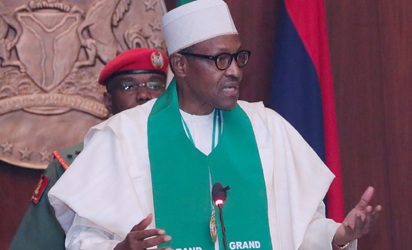
ABUJA – PRESIDENT Muhammadu Buhari on Monday gave reasons why the Nigerian Army was not hard on the separatist agitation of Biafrans during the 30 months civil war.

President Buhari explained that they had strict and formal instructions to exercise restraint against Biafrans during the three-year civil war which took place between1967-1970.

The President recalled that every military commander was issued the instructions in dispatches handed to them from the then Head of State, General Yakubu Gowon, that the Biafrans, were not enemies but brothers and sisters of the rest of Nigerians.

President Buhari stated this at the Presidential Villa, Abuja during his investiture as Grand Patron of the Nigerian Red Cross Society (NRCS).

The President who promised to assist the organisation secure permanent office accommodation in Abuja, showered praises on the former Head of State, Gen. Gowon, retd, for that gesture and also the role of the Red Cross in bringing succour to victims of the war even in dangerous circumstances.


He went memory lane over the horrible consequence of the civil war, noting that the pathetic pictures of war-ravaged Biafrans were always heartrending.

According to him, “Earlier in my profession, during the civil war, I know how much sacrifice members of the Nigerian Red Cross and their international counterparts did both in the real front of operations and at the rear, on both sides. I think it is a lot of sacrifices because anything can happen to you in the operational areas.

“The risks they faced were real and I admire their courage and commitment to helping people who were in distress and were virtually in millions. Those photographs of people from the Biafra enclave spoke a lot.

“I remember with nostalgia the performance of the Commander-in-Chief, General Gowon. Every commander was given a copy of the Commander-in-Chief’s instructions that we were not fighting enemies but that we were fighting our brothers. And thus, people were constrained to show a lot of restraint.

“The international observer teams were allowed to go as far as possible within and outside the front and I think this was generous and very considerate of General Gowon. He is a highly committed Nigerian.”

On his promise to assist the organisation secure permanent office accommodation in Abuja, Buhari said, "I have taken note of your logistics especially your(request for) office here.

"I assure you that the government will do its best when you decide to build such facilities in terms of securing an area here within the Federal Capital Territory and we hope you will not do the Nigerian ways of doing things.


"To use the words of famous Nigerian Minister `I hope you will not build an elephantine headquarters' which is going to be functional because we have seen your activities throughout the country," he said.

In his remarks, the head of delegation and National President of the NRCS, Chief Bolaji Anani, said the organization has over 800,000 trained volunteers based in communities across the 774 local government areas of the federation.


Anani pleaded with the President to assent to the Bill amending the Red Cross Act of 1960, whenever the National Assembly, which was currently debating on it, eventually passes it, noting that the Act has not been reviewed since it was passe in 1960.

THE IGBO RANT

I am an Igbo, I was born an Igbo, I live the life of an Igbo, I come from Igbo, I speak Igbo, I like to be Igbo, I like to dress in Igbo, I eat Igbo food, my heritage, culture and tradition is Igbo, my parents are Igbo.

Am sorry I cannot help it if you hate my lineage. Am sorry I cannot help it if you detest Igbo, am sorry I cannot help it if you hate me because am Igbo. Igbo is who I am, my name is Igbo and I must die an Igbo.

You see Igbo as a threat, why? You call Igbo rapist, criminals, ritualist, prostitutes, kidnappers. You attribute all negative vices to represent Igbo? Why do you do that? You do because you feel threatened that Igbo might outrun the rest of the tribes. Why do you hate Igbo and despise us? You do that because we are creative, enlightened, hardworking, industrious, genius, intelligent, smart, rich, beautiful and amazing. But its difficult for you to admit it because you feel jealous of my race.

Igbo do not own politics, Igbo do not control the economy neither do we control the natural resources and the common wealth of the nation. You do, we don't and yet, despite the fact that you own everything, we still remain one indispensable race that has outshined the other race in all ramifications.

You fear us because you want to exterminate and annihilate our race, you deny us many things and yet we are stronger, richer and mightier. You fear us because we are everywhere. You fear us because no matter how rural a place might be, when Igbo steps in, they turn it into a Paradise. We have our own resources, which lies in resourcefulness, we do not bother you and your control over the polity, but yet when we cough you and the other race begin to shiver.

Am proud being an Igbo, am proud of my heritage and culture. Igbo means high class, Igbo means independence, Igbo means hard work and strength, Igbo means riches, Igbo means resourcefulness, Igbo means self belonging, Igbo means self esteem, Igbo means pride, Igbo means swag.

Udo diri unu umunnem.
# IgboAmaka
# AnyiBuNdiMmeri

Michael Ezeaka
------------------------------

This is beautiful poetry ...

In response to Alaba Ajibola, the Babcock Lecturer Hate Speech against Igbos.

BIBLICAL TRADITIONS OF NDI IGBO BEFORE THE MISSIONARIES CAME TO AFRICA* IGBO 101.

1. NSÓ NWANYĮ
In Igboland women live apart from their husbands and neither cook for them nor enter their husband's quarters when they are in their period. They are seen as unclean. Even up till today such practice is still applicable in some parts of Igboland especially by the traditionalists. Before a woman can enter the palace of Obi of Onitsha, she will be asked if she is in her period, if yes, she will be asked to stay out.

Leviticus 15: 19-20
When a woman has her monthly period, she remains unclean, anyone who touches her or anything she has sat on becomes unclean.

2. ANA OBI
An Igbo man's ancestral heritage, called “Ana Obi” is not sellable, elders will not permit this. If this is somehow done due to the influence of the West the person is considered a fool and is ostracized by the community.

1 Kings 21:3
I inherited this vineyard from my ancestors, and the Lord forbid that I should sell it, said Naboth.

3. IKUCHI NWANYĮ
Igbos have practiced the taking of a late brother's wife into marriage after she had been widowed until the white men came. Now it is rarely done but except in very rural villages.

Deuteronomy 25:5
A widow of a dead man is not to be married outside the family; it is the duty of the dead man's brother to marry her.

4. ĮGBA ODIBO
In Igboland, there is a unique form of apprenticeship in which either a male family member or a community member will spend six (6) years (usually in their teens to their adulthood) working for another family. And on the seventh year, the head of the host household, who is usually the older man who brought the apprentice into his household, will establish (Igbo: idu uno) the apprentice
by either setting up a business for him or giving money or tools by which to make a living.

Exodus 21:2
If you buy a Hebrew slave, he shall serve you for six years. In the seventh year he is to be set free without having to pay you anything.

5. IRI JI OFŲŲ
In Igboland , the yam is very important as it is their staple crop. There are celebrations such as the New yam festival (Igbo: Iri Ji) which are held for the harvesting of the yam. New Yam festival (Igbo: Iri ji) is celebrated annually to secure a good harvest of the staple crop. In the olden days it is an abomination for one to eat a new harvest before the festival. It's a tradition that you give the gods of the land first as a thanksgiving.

Deuteronomy 16:9
Count 7 weeks from the time that you begin to harvest the crops, and celebrate the harvest festival to honor the lord your God, by bringing him a freewill offering in proportion to the blessing he has given you. Celebrate in the Lord's presence together with your children, servants, foreigners. Be sure that you obey my command, said the Lord.

6. IBE UGWU
In Igboland it's a tradition that the male children are circumcised on the 8th day. This tradition is still practiced till date.

Leviticus 12:3
On the eighth day, the child shall be circumcised.

7. ÓMŲGWÓ
In Igboland, there is a practice known as "ile omugwo ". After a woman has given birth to a child, a very close and experienced relative of hers, in most cases her mother is required by tradition to come spend time with her and her husband. During which she is to do all the work of the wife, while the new mom's only assignment to the baby will be to breastfeed. This goes on for a month or more. In the Igbo old tradition, at this time, the new mom lives apart from her husband, would not cook or enter his quarters.

Leviticus 12:1-4
For seven days after a woman gives birth, she is ritually unclean as she is during her monthly period. It will be 33 days until she is ritually clean from the loss of blood; she is not to touch anything that is holy.

THE IGBO TRIBE AND ITS FEAR OF EXTINCTION

The Igbo tribe is in a serious problem and danger of extinction for the following reasons:

50% of Igbos are born outside Igbo land. Meaning that those children are not likely to live and work in Igbo land and cannot speak Igbo language but foreign language (Yoruba, Hausa, French, English).

40% of Igbos girls between the age of 25 & 45 are single with no hope of marriage because 35% of Igbo boys live overseas and they have all married white ladies.

75% of Igbo youths leave Igbo land every year in search of opportunities in Yoruba, Hausa land or overseas.

85 % of Igbos have family houses and own investments outside Igbo land. They strongly believe in one Nigeria but failed to know that NO Yoruba or Hausa man has a family house or investment in Igbo land.

Igbos are the only people who believe that living outside their land is an achievement.

Igbos are the only tribe that celebrate their tradition outside their land e.g. Eze Ndi Igbo, Igbo Village in America and this is because they have family homes in foreign lands.

Igbos have failed to know that the children you have outside Igbo land especially overseas will never think of living in Igbo land. So what happens to the properties you are building for them when you are gone?

Igbos are the only tribe who see their land as a place to visit or a tourist site than a place to work and live.

Igbos are the only tribe who instead of promoting and appreciating their culture through movies and documentaries they have sought to ridicule it by portraying rituals, killings, wickedness, love for money and other social vices which were not originally inherent in our culture thereby cursing more harm than actually promoting their culture.

Igbos are the only people who without hesitation believe their history and description when it is told or written by an enemy or a foreigner. E.g. that you do not love yourselves or that you love money.

Igbos are the ONLY largest tribe on earth who fought for their independence and failed to achieve their freedom after 40 years.

Igbos are the only tribe who fails to honour their brave heroes and heroines especially the innocent children starved to death during the Biafran war.

Igbos are the only tribe who embraced their enemy after a bloody civil war and subsequently become slaves.

Igbos do not find it necessary to teach their own version of history to their children.

Igbos fight for marginalisation in Nigeria but has no collective strength or teeth to bite.

Igbos how long are you going to fight for your relevance in Nigeria?

How long are you going to fight for a functional airport, rail networks and other structural establishments that underpin sustainable development?

How long are you prepared to wait for your enemy to guide you to your destiny?

Oh Igbos!
Where are your leaders?

Unfortunately, none of them live and work in Igbo land. If you wish to save the future of your children, your identity, your generation and your race then you need freedom and that freedom is Biafra.

Ukpana Okpoko gburu bu nti chiri ya!

By Chime Eze
#COPIED

RT. HON. DR. NNAMDI AZIKIWE TO DR. CHUBA OKADIGBO (1981)

"My boy, may you live to your full potential, ascend to a dizzy height as is possible for anyone of your political description in your era to rise. May you be acknowledged world-wide as you rise as an eagle atop trees, float among the clouds, preside over the affairs of fellow men.... as leaders of all countries pour into Nigeria to breathe into her ear.

But then, Chuba, if it is not the tradition of our people that elders are roundly insulted by young men of the world, as you have unjustly done to me, may your reign come to an abrupt and shattering close. As you look ahead, Chuba, as you see the horizon, dedicating a great marble palace that is the envy of the world, toasted by the most powerful men in the land, may the great big hand snatch it away from you. Just as you look forward to hosting the world’s most powerful leader and shaking his hands, as you begin to smell the recognition and leadership of the Igbo people, may the crown fall off your head and your political head fall off your shoulders.

None of my words will come to pass, Chuba, until you have risen to the very height of your power and glory and health, but then you will be hounded and humiliated and disgraced out of office, your credibility and your name in tatters forever...”
THE REST IS HISTORY AS EVERY WORD OF THE CURSE ON CHUBA CAME TO PASS.

LET'S BE AS PASSIONATE AS WE WANT TO AND BE MODERATE IN OUR CONTRIBUTIONS IN PUBLIC DISCUSSION TO ISSUES AS WORDS OF OUR ELDERS ARE WORDS OF WISDOM

The Igbo: We die for causes, not for personalities

Written by Emeka Maduewesi

~on fb. 28th September, 2016.


The Igbo will never die for anyone. We will not even riot for anyone. But the Igbo will die for any cause they believe in because the Igbo have a true sense of justice and a determination to obtain it.


The Igbo will not riot because one of their own lost an election. Operation Wetie was the Western response to a massively rigged 1965 election. The Yoruba doused fellow Yorubas in petrol and burnt them alife. Properties were burnt with occupants. The Igbo will never do this.


In 1983, the Yoruba went on a rampage again over the massive rigging by NPN. Lifes were lost and properties destroyed. The riots were over personalities.


Contrast that with Anambra State where Chief Emeka Ojukwu was rigged out by his own NPN, who also rigged out Chief Jim Nwobodo. The Igbo did not protest because the goat's head is still in the goat's bag.


In the North, ba muso was the battle cry when Sultan Dasuki was imposed on the Sokoto Caliphate. The riot and protest lasted for days and crippled economic activities.


The Igbo will riot over issues and causes. The Aba Women Riot was over Tax. The Enugu coal mine riot was about conditions of service. The Ekumeku Uprising was over British colonialization.


Those of "Ekumeku" ancestry - Umu Eze Chima and Umu Nri - were at the forefront of the struggles for Nigerian independence, with people like Dr. A A Nwafor Orizu and Chief Osita Agwuna serving prison terms. Any struggles the parents could not conclude is continued by the children by other means.


The Biafran war was a response to the genocide. The war in fact was brought upon us. The battlefield was Eastern Region. The war ended in 1970 but the issues and causes were not resolved. That is where we are today.


The Igbo will also jointly rise to fight evil in their midst. They did it in Onitsha in the 1980's, Owerri in the 90's, and with Bakkassi in the 2000.


The Igbo will not die for any man. But the Igbo will stand by any man who symbolizes their cause and their pursuit of justice. Even if the man dies, the struggle continues, and like the Ekumeku warriors, the children will pick up the baton from their parents.


This is the Igbo I know, the Igbo I am, and the Igbo we are. This is my story. Feel free to tell yours.

Biafra Videos: Explosive secret about Biafra...

Popular Posts