Search this Site and the Web

Showing posts with label Cultural. Show all posts

Thursday, August 10, 2023

"CHI" IN IGBO THOUGHT AND CULTURE

Written by Rev. Fr. Francis Anekwe Oborji, Pontifical Urban University, Vatican City (Rome)
Email: anekwe.oborji@gmail.com

Monday, July 10, 2023

Our concern in this short write-up is to articulate, briefly, the true meaning and significance of the concept, "CHI" among the Igbo in the context of the concept of the "Person" in African thought and culture as articulated in Igbo, African scholarship in recent years.

The Problem:

The pre-theoretical concern about the concept of the person in philosophical and theological discourse challenges us to give a unique and coherent response to the following questions: What is the person? What does it mean for a person to be the same persistent entity through time (or in a moment of time)? How many distinct ontological entities constitute a person? What relationship, if there is, exists between the subjective experiences of an individual first-person and our perspective third-person? What is the influence of our culture and society on our system of thought and interpretation of reality and 'non-regular causation' of things in the universe? What kind of relationship exists between the thinker and his cultural and religious context? What is the influence of this cultural context on our philosophical and theological thoughts?

The African scholars, especially, philosophers and theologians, including the Igbo scholars, take seriously the challenge of giving an adequate response to these questions in the African, Igbo context and perspective. This is why in the African, Igbo context, unlike that of the West, plausible answers to an application, are usually informed by plausible answers to other questions.

Therefore, to appreciate the rich meaning and significance of Igbo concept of "Chi" in the context of the concept of person in African thought and culture, I would like to explore the way in which the Igbo, African theory of the universe and of the ontological reality has provided us with the integrated responses to the question under consideration. And how we must build these answers on it. My approach, partly descriptive and partly imaginative, should be familiar; I adopted it by the tradition of the first African scholars, from their reaction as well as their appreciation of the pioneering work of Placide Tempels, La Philosophie Bantoue, published in 1945.

SHOP AMAZON: Car & Vehicle Electronics

Thursday, July 16, 2020

Bastardisation of Igbo chieftaincy titles no longer acceptable - Ndigbo

*It is worrisome, we should fashion a general rule to safeguard our cultural values - Ohanaeze
*Monarchs should scrutinize recipients - Eze Nwabeke

*Some monarchs debased titles by advertising them on social media - Ozo Anaekwe

*It is against natural justice to give chieftaincy titles to people of questionable character - Igwe Ukuta

VANGUARD  Wednesday, July 15, 2020
By Anayo Okoli, Chimaobi Nwaiwu, Ugochukwu Alaribe, Chinedu Adonu, Chinonso Alozie & Ikechukwu Odu – Enugu

Ab initio, in Igbo land, chieftaincy titles are conferred only on illustrious men and women who have distinguished themselves in one thing or the other.

Some of them through their philanthropic disposition built roads, schools, churches, industries, markets, instituted scholarships to the people and other commendable and developmental projects/activities. Then, chieftaincy titles had value and respect. They were not common because they were not gotten easily.

But today, the situation has changed for bad. Chieftaincy titles no longer carry weight; they have lost their respect and value as they are purchased from traditional rulers, some at ridiculous prices.

Monarchs now dish titles out to even men of questionable characters, including known fraudsters, just because they have the money to throw around. Today, the once prestigious titles meant for men of good heart and goodwill have been bastardized and almost made worthless.

This, no doubt is giving some Igbo people concern, including the apex Igbo body, Ohanaeze Ndigbo. Some Igbo leaders, traditional rulers inclusive attributed the problem to various issues.

Ohanaeze Ndigbo, in particular, regretted that the cultural values of Ndigbo have been badly eroded in every aspect to the extent that chieftaincy titles now go to people with very questionable characters.

According to Prince Uche Achi-Okpaga, the national publicity secretary of the apex Igbo body, the bastardization of chieftaincy titles is part of the entire mess Igbo culture and tradition have gone through.

"The crux of the matter is that our cultural values have been ferociously eroded in all ramifications. The issue of chieftaincy titles does not exist in oblivion. It is part of the entire mess.

“Our young men, in the words of Prof Chinua Achebe, "…whose palm kernels were cracked by benevolent gods…" covet chieftaincy titles as if their lives are tied to it.

Monday, March 12, 2018

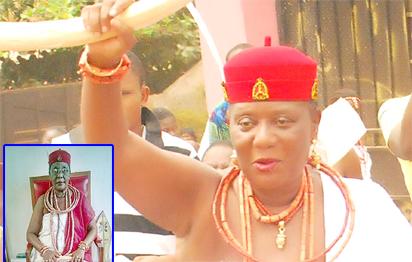
Female Traditional Ruler: At a point during my coronation I became a man - Obi Martha Dunkwu, Omu Anioma, Delta State

Written by Jimitota Onoyume, Asaba
Sunday, March 11, 2018


Omu Anioma
Obi Martha Dunkwu, Omu Anioma is a notable female chief in Delta State. In this interview, she speaks on how she oversees the affairs of her community. She spoke on the side lines of Peaceworks, a Niger Delta dialogue facilitated by Dr Judith Asuni of Academic Associates.

Were there battles you fought to ascend the throne?

There were no battles. Our forefathers set up the Omu traditional institution over 700 years ago. In Aniomaland, from Asaba to Agbor, among others, the forefathers designed that every community must have a traditional ruler but in Omu, we have a traditional ruler who is a man and another who is a woman. However, the male traditional ruler is superior in communities where there is also a female traditional ruler because man comes first, and, when you are crowned as in my case in Omu, you must come to the palace to reign; you must leave your marital home. At the point of coronation, you are bestowed male rights; that is why you can break the kolanut, you become a man and a woman put together. I tried to find out why. 


Research shows that God created man and woman, but it is the woman that is better positioned to understand woman. That is why the Omu means Eze Nwanye, female king in charge of women, female youths, markets, ancestral shrines, businesses. More importantly, she is the spiritual custodian, the one who advises the male traditional ruler and the town spiritually. That is why they felt this woman should not be married so she can be in a state of chastity. The woman is also seen as the mother of all in the town. If you are living with a man and he slaps you, it is believed to be a slap on the town. But as Omu, you can marry out children who will bear children for you. Female chiefs of Omu are patterned in a way that they are different from male chiefs. There is no contest. You don't aspire to it. It is God who reveals who will become the traditional ruler for women. In some Anioma communities, it is hereditary; in others, it is rotational.

What is the experience like? How do you operate in an environment in which many believe royalty exclusively belongs to men?

Because I am a media practitioner, I have brought visibility to the Omu throne. Definitely, men will not feel at ease. And of course some traditional rulers will not feel at ease but it is not a modern creation; it has been there for ages and there is nothing they can do about it. Our forefathers wanted the woman to play her role and the man to also play his role to move the community forward. I am a member of the Omu traditional rulers' council to speak for women. And in case there is trouble, it is easy for you to come in. I have my own palace and chiefs. In my area, you find men who are not comfortable with my status but I did not choose myself; it is spiritual. I just want the hand of God to continue to be on my head. I don't want anybody to like me. I just do the right thing, do what the ancestors want me to do.

Monday, March 5, 2018

THE ANCIENT FEMINISM OF OLD IGBO TRADITION

(The Female POPES of IGBO Ethnic Group)

~as shared by Stephen UYANNE - Awka.

THE QUESTION
A child belongs to his fatherland and not his motherland; and yet, we say 'NNEKA' - 'Mother is Supreme.' Why is that?'
(Things Fall Apart - pg 106)

I was born in the eastern part of Nigeria, Igbo Tribe. It does not in any way represent the whole Africa, but allow me to tell you about my forefathers and the place of a woman in the ancient Igbo tradition and custom. One of the biggest lies in the world's history is the record that claimed that women were objectized in Igbo Land. There is no truth in it.  

In as much as Igbos - like every patriarchal society of the old -
 prefered male children, their daughters were their pride. A woman perpetually belongs to her father's house. It is called 'Okputolokpu' - everlasting, that is why every Igbo community calls grown daughters born in a family - Umu okpu. This explains why a man can never finish the marital rites of a woman in Igbo land. During bride price, no Igbo community would accept everything offered as dowry. The reason is that the woman is priceless.

That is why, in Igbo tradition and custom, when a man beats his wife, the wife can return to his father's house. It is not a taboo, and before the husband can take the woman he MUST -according to the tradition - go to his in-laws with a pot/bottle of wine. 

NO ONE IN HISTORY HAS EVER FINISHED PAYING THE DOWRY OF AN IGBO WOMAN FOR SHE IS PRICELESS

One of my oldest relative had only sons and no daughters; he normally said to his sons, 'You do not have a sibling yet.' 


In the Igbo ethnic group, a child belongs to the fatherland but is referred to as the child of the mother. The term 'Siblings' is generally known as 'Nwanne'  (trans. the child of my mother because men were polygamous, the children of your mother are your siblings). 

A male sibling is 'Nwanne m Nwoke' (The male child of my mother)

A female sibling is 'Nwanne m Nwanyi' (The female child of my mother). 

That is why the people of Igbo Ethnic group practise what is known till this day as 'Nwadiana' (meaning The Child of the Soil)

NWADIANA
'Your' Nwadianas are the children whose mothers were married from your family. 
Example: My sister's children are my Nwadianas. In Igbo custom, I am their Nna Ochie - ancient fathers. 

Friday, June 16, 2017

Who are the Igbos: Igbo ancient village in America - video

Topics (Video):
  •  IGBOS LIVED BEFORE ADAM!
  • Elaudah Equiano - History 101
  • Igbo ancient village in America
  • We are the Igbos
__________________________

 IGBOS LIVED BEFORE ADAM!
-------------------------------------------

Elaudah Equiano - History 101
Chukwu Abiama - God of Abraham! Circumcision on the 8th day...
~28th March, 2017

---------------------------------------------------------

Tuesday, March 7, 2017

Jewish scientists visit Nnewi to test ancestral connection with Igbo

~The SUN Nigeria. Wednesday, February 8, 2017.

Former President-General of the Ohanaeze Ndigbo, Dr. Dozie Ikedife, has invited Jewish scientists to carry out Deoxyribonucleic Acid (DNA) test at his hospital to ascertain the possibility about an ancestral relationship between the Igbo people and Jews in Israel.

The Jews have been carrying out the tests at Nnewi-Ikedife Hospital located along Igwe Orizu Road, Otolo-Nnewi, Anambra State.

Hundreds of people trooped out in their numbers, on Tuesday, February 7, to participate in DNA test to ascertain the validity of the claims that the Igbo migrated from that part of the world.

As early as 7.00 am people had started arriving to take part in the cell screening exercise, while a few policemen were seen in the hospital premises to ensure a hitch free DNA exercise.

While addressing newsmen on the exercise, the former president general of Ohanaeze Ndigbo, said there had been stories of Jewish/Igbo relations based on archaeological discoveries and mythology, saying he facilitated the Jewish scientist to come and prove the mythology.

He said the Israeli-Yaweh group came into the country to take a random sampling of cells from the people in the South-East for studies to carry out a DNA analysis and comparison in Houston Texas USA.

"The idea is to establish scientifically the relationship of the two groups of people. It is necessary to satisfy the curiosity and answer the question in the minds of many for quite some time.” he said.

Concerning the possible outcome of the tests, the former Ohanaeze president said: "If at the end of the day, it is confirmed that we are relations, we would remain brothers and friends, but if it proved negative we remain friends. My curiosity is based on the fact that I studied Anthropology as well as Medicine, the result of the cell examination is expected to be out in August this year."

OHANEZE: Ohaneze must reposition

Written by Obi Nwakanma
~Vanguard Nigeria. Sunday, March 5, 2017.

In January, Ohaneze Ndi Igbo, elected Mr. John Nnia Nwodo as its new President (never mind the tautology "President-General"). Not a few Igbo breathed a sigh of relief on account of the fact that Nwodo was the right sort of peg in the right sort of hole.

Let me recast a little background to the beginnings of Ohaneze as a group. But before then my source: as a young reporter in the 1990s, I visited Dr. Akanu Ibiam in Unwana, Afikpo - tracing my path from Enugu, where I'd first been directed to meet him.

He was a lean and Athletic man even then already in his 80s, and looked nothing like what I'd imagined, a "king," with all the paraphernalia of masqueradry I associated with such buffoonery in Igbo land. Dr. Ibiam wore a simple print shirt that day, and had on, not a crown, but a beret that made him look more like a French bohemian than an Igbo monarch.

And I did ask how an elder of the church of Scotland, a Presbyterian in fact, and former missionary doctor ended up as a king. It was Dr. Ibiam who first reminded me in fact that the word "Eze" did not necessarily mean "king" in the Igbo language.

"I am not a monarch in the imperial sense of the word. I am a justice of the peace, and keeper or trustee of the powers of my people in Unwana." It all began in 1970, when the old guard of Igbo political leadership, mostly former ministers of the government of the East met, first at the home of J.M. Echeruo in Enugu, in a meeting with the British Minister Lord Carrington, which set the tone for discussions on the strategic reconstruction of the East from the devastations of war.


But there was also in the background, the plans for a full political re-integration, which required that the old political guard, not long out of power return to the grassroots, regroup, and prevent the planned insertion of political subverts into the Igbo communities aimed at weakening Igbo political interests from the center.

These former political leaders of the East agreed to bid their time at their local community levels, and stand as bulwark against the political threats against the Igbo at the end of the war, in preparation for Gowon's political transition billed to commence in 1974.

Friday, January 27, 2017

Why Chinese are leaving Nigeria for their New Year Holidays - Envoy

From News Agency of Nigeria.
~The Punch Nigeria. Thursday, January 26, 2017.

Mr Chao Xiaoliang, Consul-General of the People's Republic of China in Lagos, on Wednesday said that thousands of Chinese were leaving Nigeria for the Chinese New Year celebration.

Chao saidin Lagos that the Chinese New Year, also known as the Spring Festival, was an official public holiday for all Chinese nationals to reunite.

According to him, the Chinese New Year is a memorable celebration that any Chinese, irrespective of location and engagement, cannot afford to miss.

"Already, many Chinese in Nigeria, like all other Chinese all over the world, have started leaving Nigeria for their different places in China for the 2017 Chinese New Year.

"For the past 3,000 years, Chinese nationals, wherever they are, are expected to return home to celebrate this enjoyable New Year with their families and friends.

"It is a period for all Chinese to celebrate a year of hard work, have a good rest, relax with family, as well as wish for a lucky and prosperous New Year,'' he said.

Chao also said that some Chinese business owners, who wanted to use the New Year Celebration to celebrate their business successes with their Chinese employees in Nigeria, had started arriving.

The Envoy said that the celebration would usually commence with the decoration of every Chinese street and buildings with red, the main New Year Celebration colour.

Chao also said that it was common practice during the celebration, to see red lanterns hung in streets and red couplets pasted on doors, as symbols of the year's prosperity.

He said that the celebration would include the families' New Year Eve dinner, known as Reunion Dinner,'' the presentation of red envelopes with money as gifts, the setting off fireworks, wearing of new clothes.

"Let me say that this period is really a period for us Chinese to enjoy ourselves, because we have been working all through the year.

Every Chinese, whether Christian, Muslim, Buddhist or other religious believers, must usually create time to reunite with their families and friends during the New Year celebration,'' Chao said.


Sunday, December 11, 2016

Igbo culture and its struggle in US


Twitter.com/achosr.
~The SUN Nigeria. Thursday, December 8, 2016.

Culture, perhaps its maintenance, has been on the mind of many Nigerians, especially Ndi-Igbo in the Diaspora as they constantly think of what would become of their children when they exit this earth. Majority of the Igbo people in the North America make extra effort to instill Igbo culture in their children. Many Igbo families have tried to speak Igbo language at home so that their children will pick up that aspect of Igbo culture.

Others have been telling their kids Igbo stories to leave the mark in their children's mind. Yet, there are some who take their kids to Nigeria every year so that they would grow up to appreciate their heritage. There are other families who have sent their children to Nigeria for their primary and secondary education. Nonetheless, no matter how hard they try, the effort seems to be a losing proposition because of the multicultural dynamism inherent in the environment these children are growing up.

However, with such an adversity, there is equally a greater amount of effort to promote and maintain Igbo culture in the United States by various Igbo communities and individuals. These communities and some individuals are driven in part by the notion that without culture a group loses its identity. They dread the reality of their children losing Igbo identity. Thus, there has been a concerted effort to immerse these children in Igbo culture. Additionally, it is concluded that teaching our children our culture is a means of strengthening the ties between Igbo people with their children in the Diaspora and those in Nigeria.

Examining the following aspects of Igbo culture: Arts, Celebration, Clothing, Communication, Food, Government, Language, Religion, and Social Role; Igbo language is one aspect that is fast decaying both here in America and in Nigeria. Like in America, Igbo children in Lagos and other non-Igbo cities do not knowledge of or modicum of Igbo language. Lack of knowledge of Igbo language among our children is much more obvious here in the United States. This is particularly so because Igbo is not a dominant culture and these children are growing up in a multicultural environment. Consequently, more emphasis has been placed on celebration, clothing and food than other aspects of Igbo culture.

In the United States, particularly in the Dallas Metropolitan area, Igbo communities have been working diligently to promote and maintain Igbo culture every chance they get. Common among various aspects of Igbo culture these communities promote are the traditional breaking of kolanut, which oftentimes causes problems when the libation goes wrong; celebration, clothing, ethnic food, and cultural dances. Unfortunately, little focus has been on the teaching and learning of Igbo language corporately.

Thursday, December 8, 2016

Secrets of Ozo title

Written by Aloysius Attah, Onitsha
~The SUN Nigeria. Wednesday, December 7, 2016.

- Why Enugwu-Agidi Ozo titleholder must live in affluence, keep money for burial

Across the length and breadth of Igboland, Ozo title is a major symbol of prominence. The title-taking event is typically organized with an abundance of yam, meat, wine and other staple foods, all of which symbolize prosperity in the Igbo culture.

A close observation of the Ozo title-taking ceremony across the states of the South-East geo-political zone gives one an opportunity to see the slight variations in the ways the several communities organize and manage the auspicious event.

Igbo culture is not a straitjacket one that is made up of meaningless rituals.

The Igbo believe in customizing and personalizing their culture. That explains the variations seen in the ways the several communities handle their Ozo title-taking event.

Typically, for an Igbo man to become an Ozo titleholder, he must be wealthy. This gave rise to the Igbo saying that "Ichi ozo bu maka ndi ogadagidi," meaning that taking the Ozo title is an affair for the high and mighty.

Daily Sun was at Enugwu-Agidi community in Njikoka Local Government Area of Anambra State recently to witness the Ozo title taking ceremony of four brothers.


Though the Ozo title taking is such a money-consuming ceremony, the Nwakwo brothers: Olisaemeka Nwankwo, Ugochukwu Nwankwo, Tochukwu Nwankwo and Chukwuma Nwankwo, did not only host the entire community, but Chukwuma upped the ante when he also initiated his three little sons into the clique, bringing the number to seven.

It was a day the people of Enugwu-Agidi community will not forget in a hurry even as the newly initiated Ozo title holders said they have no regrets doing that since "they have arrived and also did what their late father once did."

At the compound of the Nwankwos, festivities were at a high pitch with dancers, musicians and other entertainers thrilling the audience even as the Ozo titleholders were busy enjoying their entitlements.

As the ceremony got underway, Ozo Fred Onubogu in a chat gave an insight on steps an aspirant for the Ozo title has to take before joining the exclusive league:

"I am an Nze na Ozo title holder too, and what we are doing here is spectacular because it is not easy for one family to produce seven Ozo title holders in one day. The bill is more than N8 million. Before they are initiated, each one of them must deposit N1 million in the bank, into the Ozo title holder's account. This is for security reasons in case of any eventuality because if an Ozo man happens to die, you don't have to go and start borrowing money. We don't suffer to give the last respect for a departed Ozo member in Enugwu – Agidi because the budget has been taken care of while the person was alive. Planning it in this form saves a lot of high blood pressure for the family members of the departed Ozo man.

Wednesday, December 7, 2016

Throwing lavish party for the dead

Twitter @okeyndibe
~The SUN Nigeria. Tuesday, December 6, 2016.
I have said this before: One of the hardest tasks is to predict how Nigerians would react in any given situation. We are a perplexing bunch, able to defy the most skilled pontificator.

Imagine, then, my constant frustration. As one who has written for years on Nigerian affairs, I am often asked-both by audiences in Nigeria and abroad-to pronounce on the likely turn of events in my country of birth.

Often, in a mood of humility, I give the only response that makes sense. I confess that I don't know. I tell the inquirer that Nigeria is a puzzle, a phenomenon whose behavior no human can anticipate or predict with high confidence. Sometimes, when I speak in this vein, I provoke laughter in the audience. Those listening to me appear to think I'm joking, and if not speaking in jest, that I am a man who has cultivated great modesty.

They seem to believe that my plea constitutes evidence of an expert deliberately posturing as an ignoramus. At any rate, they regard me as one who is possessed of insights he would not-for whatever reason-share.

Of course, it's not always that I hearken to the inner voice of wisdom. Sometimes pride kicks in, and I succumb to its temptation. I seek to leave the audience with the impression that I know what I don't know. Fueled by a particular sense of vanity, I venture forth with a categorical statement on how a particular matter would play out in Nigeria. I go to town. I weigh in; I play prognosticator; I make declarations.

In effect, I put on the mask of an expert (a being who, according to a joke my father-in-law relished telling, is somebody who can mislead you with confidence). When seized by that urge to play an expert, I wont to tell an audience that, given a set of circumstances, this or that was bound to happen in Nigeria.

Wednesday, September 21, 2016

Nnanna’s 'Non-existent Igbo slaves in Bonny’

Written by Patrick Dele Cole
~Vanguard Nigeria. Tuesday, September 20, 2016. 

I AM somewhat surprised by Mr. Nnanna's rebuttal of my piece on the Origins of Nigerians. I normally expect criticism and even abuse to some of my views but his answer seems unfortunately to be something he wanted to say and was looking for an opportunity to do so.

It is a pity. He claims that there were "non-existent" "Igbo" "Slaves" in Bonny and other Ijaw city states; basing his conclusion on a belief that ethnical classification of "Igbo" and "Ijaw" was some white men's invention and curiously that an artifact from Abiriba was found by Professor Isichie in Bonny.

That many Abiriba have names like Ubani (presumably a corruption of Igbani) and that I confused trade and cultural relationship between the Igbo and Bonny as a relationship of master and slave. Finally that I somehow managed to damage Chief Ekwueme's chances of becoming President because working for my "mentor",

President Olusegun Obasanjo, I, in some inexplicable way, influenced Obasanjo's choice, thus climaxing a deep plan to sow confusion between various ethnic groups. What disturbed me most was that his piece left some idea that I, in cohort with others, hatched a plan to sow ethnic division in Nigerian. For him it is "just playing to the gallery, deployed by people with ulterior and unwholesome mindset to create divisions to get people fighting one another.... celebrating this fallacy". I reply solely to refute the insinuations littered throughout the piece about hidden strategy to deride and divide the Igbo and other Nigerians, thus preventing them from living peaceably with their neighbours.

As to the indictment of Obasanjo being my mentor and somehow making this affect Dr. Alex Ekwueme's chances of being the President, I am beyond surprise that a respected columnist as Mr. Nnanna, without a stirred of evidence could peddle such baseless accusation. What exactly did I do to harm Dr. Alex Ekwueme? Nevertheless, I am flattered that I was so powerful to be able to influence People Democratic Party, PDP, Obasanjo was never my mentor. He was my President and I was his Adviser and friend.

I have been on record celebrating the achievement of the Ibo. My parents spent over 40 years working among the Ibo in Enugu, Abakaliki, Enugu Ngwo, Udi, Aba and Onitsha. There is a Cole Street in Onitsha. I probably speak better Ibo than many Ibo people. My first language is Yoruba, the second Ibo, third Ijaw and fourth Hausa. I do not claim that I speak all equally well, but when both your parents are civil servants posted to all parts of Nigeria, you tend to pick up languages easily.

Imo outlaws female circumcision

Written by George Onyejiuwa, Owerri
~The SUN Nigeria. Tuesday, September 20, 2016. 

Imo State Governor, Rochas Okorocha says the ancient practice of female circumcision has been outlawed in the state, warning that offenders risk jail terms without an option of fine.

Okorocha, who stated this yesterday, during the official launch of the campaign against Female Genital Mutilation (FGM) disclosed that a bill to that effect would be passed into law by the state Assembly .

According to him, such barbaric culture, which is harmful and not beneficial to the people, ought to be abolished, noting that Imo was still one of the states in the South East where female circumcision was widely practiced.

" This harmful ancient practice has been outlawed in this state and a bill to put a permanent stop it will be passed into law very soon and let me warn those who are still indulging in this practice to be ready to go to jail if caught because there would no option of fine," he said.

Speaking earlier, the wife of the state governor, Mrs. Nkechi Okorocha, who initiated the campaign in collaboration with the United Nations Fund for Population Agency (UNFPA), said women in the state have vowed to put an end to the barbaric practice which is not beneficial to the girl child.

Mrs. Okorocha further explained that the continual practice of Female Genital Mutilation must be stamped out in the state, especially in the rural areas, where the practice is prevalent and led to emotional trauma, broken homes and even death.

The Country Representative of UNFPA,Mrs Beatrice Mukta, disclosed that the organisation has been campaigning against the practice in most African Countries where the practice still subsist.

She commended wife of the governor for her relentless fight against FGM, noting that the battle against the ancient practice which is steeped in cultural myth may not be an easy one. she appealed to traditional institutions as well as women in the state to support the campaign.

Mrs. Okorocha had kick started the campaign against FGM/ Cutting with a protest match in which over 500 female students drawn from various schools in the state and women participated.

Thursday, September 1, 2016

Bizman emerges Eze Ndigbo Malaysia

Written by Dotun Ibiwoye
~Vanguard Nigeria. Wednesday, August 31, 2016

KUALA LUMPUR-The Igbo community of Malaysia weekend crowned, Chief Izuchukwu Nwajiaku, a renowned exporter,the Eze Ndigbo Malaysia.

Chief Nwajiaku in his acceptance speech, said there was an urgent need for unity amongst the Igbo living in Malaysia, emphasizing more on brotherhood.

He also advised them to be law abiding ciitizens and show respect to their host community, and avoid anything capable of bringing bad reputation to the community.

Presenting a staff of office to Chief Nwajiaku, President General of Ohaneze Ndigbo, Malaysia chapter, Biafra Diboh urged the newly crowned Ezendigbo to continue with his good worksthat saw the entire community agreed to crown him.

The event which was witnessed by large crowd of Africans and Asians who thronged the place to witnessed displayed of various Igbo culture that were displayed took place at the multi purpose Auditorium Hall of The Club ballroom, Bukit Damansara, Kuala Lumpur, Malaysia.

According to Diboh: "Keep on the good work and hopefully you lead us- your people to the promised land. We need to make a positive impact anywhere we find ourselves. In the eastern part of Nigeria and other places around the world. We the igbos have built a reputation of entrepreneurship and constant progress"

Thursday, July 21, 2016

Yoruba Obas’ crowns: The mystic, the taboo

~Nigerian Tribune. Tuesday, July 19, 2016

Aside the long staff and horsetail, one important paraphernalia of Yoruba traditional rulers is the crown which affirms and also asserts the monarch’s authority. TUNDE BUSARI, in this piece, examines the history, significance and the making of the crowns.

There are different Yoruba versions of the history of Yoruba Obas’ crown. What the versions, however, share in common is their acknowledgement of the primacy of Ile-Ife as the source of the crown from where other Obas received theirs.

The Olugbo of Ugboland, Oba Frederik Obateru Akinruntan would always declare that his town, which migrated from Ile-Ife, owns the first ancient crown.

Although his claim is open to debate given the fact that Oduduwa, the progenitor of Yoruba race is regarded as the first to wear beaded crown, Oba Akinruntan says his crown predates the arrival of Oduduwa to Ile-Ife.


Regardless of the side the argument swings , the crown is an important insignia of the stool in Yorubaland.

It comes in two types. One, Are Crown, regarded as the ancient one, is worn only by the Ooni of Ife. It is put at coronation and on annual basis. It is also called Adenla and conically shaped and attached with heavily beaded veil that covers the face of the Oba.

According to the Alayemore of Ido-Osun, Oba Aderemi Adedapo, the Are crown is a supreme crown which spiritual essence cannot be over-emphasised. Until certain sacrifice is made, it is not put on the head of the Ooni.

Friday, May 20, 2016

How Igweship tussle is ravaging Igbo communities

Topics:

  • How Igweship tussle is ravaging Igbo communities
  • Olubadan's intervention fails to resolve Igbo leadership crisis

_________________________________

How Igweship tussle is ravaging Igbo communities
Written by Chidi Nkwopara, Nwabueze Okonkwo, Chimaobi Nwaiwu, Peter Okutu, Chinenyeh Ozor and Ugochukwu Alaribe
~Vanguard, Nigeria. Wednesday, May 18, 2016

Most communities in the five south east states of Abia, Anambra, Ebonyi, Enugu and Imo are currently experiencing crises over selection or election of their traditional rulers known severally as Eze, Obi, Onyishi or Igwe, investigations by the South East Voice have revealed.

It was learned that although the roles of traditional rulers were not properly defined in most of the over 1000 communities in the zone, the selection of monarchs had become so contentious that it was the number one divisive problem in the five Igbo states.

Like the popular Oluwale Market in Lagos State, where all types of fake certificates are printed and sold to would be buyers, traditional ruler-ship in Igbo land has been so bastardized that known criminals now bear the certificates.


The various governments treat traditional rulers or Igwes like civil servants. Most of them are made to stay on the roads for hours with school children, waiting for visiting government functionaries under the sun. The traditional stool is not given on merit but the party you belong to or the people you know in government, hence the acrimony in most of the communities in the South East over the issue. In all, over 40 percent of the cases in various courts in the five states are related to chieftaincy disputes.

IN THE BEGINING

Apart from warrant chiefs appointed by the British colonialists mainly for the defunct Eastern House of Chiefs, only very few communities had traditional rulers in Igbo land before the late seventies as the people had various ways of governing themselves. Among such communities included Onitsha, Aro-Chukwu, Nri, Igbo Ukwu, Awka, Awka Etiti and Aguleri.

In Enugu Ezike which has a distinctive tradition in Igbo land, the oldest man in the area was the Onyishi or traditional ruler as the people practiced gerontocracy. It is only in Enugu Ezike that people do not kill themselves to become the Onyishi as people in the same age are aware of each other’s ages. In cases where ages of men were disputed, they had traditional ways of settling same instead of resorting to the courts or self-help. The eldest woman in any community also becomes the Ede Umuada.

Monday, January 11, 2016

Ojukwu led us to clear Nnewi evil forest - Igwe Orizu

The many colours of the Ofalla festival

Chief Nwafor Orizu (middle)
The foremost educationist and a former president of Nigeria, Chief Nwafor Orizu, of blessed memory, was an Nnewi man. At a time many of the communities across the country can not boast of a single motor car, the town already had a multi millionaire in the person of Chief Ohukwu whose luxury car was used to convey the visiting Queen of England round the country when she visited Nigeria many decades ago.

Nnewi is made up of four quarters, Otolo, Uruagu, Umudim and Nnewichi, with each of the independent but interrelated communities in the town having its own Obi. Otolo-Nnewi, however, produces the paramount traditional ruler of the town in the Orizu royal family. The succession system is hereditary which automatically removes the tension and acrimony associated with installation of a new king in Igboland in particular and Nigeria in general. It has insulated the kingship from opening it up for the highest bidder.

When destiny beckoned on Igwe Dr Kenneth Orizu 111 to mount the throne of his fathers 52 years ago, it was obvious that the man with the Midas touch would turn things around in the then sleepy community. Igwe Nnewi was instrumental to the establishment of the Nnewi main market after the idea was mooted by Dim Chukwemeka Ojukwu(Ikemba Nnewi) of blessed memory. The paramount traditional ruler also played a pivotal role in the industrialization of the town as he single-handedly carried the gospel of transiting from buying and selling to the setting up of industries to the affluent ones in his town. He assisted many industrialists to get land for the smooth take off their outfits.

The royal father, while talking about his staying power, said: " It was God that helped me but then I worked very hard because I knew that if I must break the poverty circle, I must work very hard. I was ready to do just anything with my hands even if it was laboring to make money for myself. My salary was less than nine pounds when I joined Outlook Newspapers but it rose to 52 pounds before I left in 1962." Orizu was instrumental to the bringing of electricity, post office and an educational institution to Nnewi which today has assumed the status of a city.

Thursday, December 10, 2015

AGULERI The Holder Of OVO NDIGBO

First published on Aka-Ikenga.com: 3/6/2007, 1:18 PM Western African Time
By Duru, Blessing .O.

Who are the Ndigbo?
One who does not know where he or she comes from can never know where he or she is going.
Likewise, he or she who is ignorant of yesterday can never do well tomorrow.


Every Yoruba or Hausa child you ask about his origin will tell you about Oduduwa and Abuyazid respectively, and also tell you where they migrated from. On the contrary, an Igbo man or woman will know who colonized America, where the people came from but is ignorant of the origin of the Igbo people. Worst of all, our so-called great historians are yet to reach agreement on the origins of the Igbo people. Some of them even went as far as accepting the white man’s distortion of Igbo spellings like Awkuzu (Okuzu), Onitsha (Onicha) etc. Our people are not yet ready to sit up and work. This attitude has led to three different schools of thought as regards the Igbo origin.


One school upholds the Igbo homeland hypothesis. They maintained that the areas identified as the primary core of the Igboland comprises Nri-Oka, Olu, Owerre and parts of Okigwe. They claim that it was from the heartland mentioned above that different people migrated to various present day Igbo.


It is unfortunate that the Aro people subscribe to this view. They forget that what we have is the “Eri-aka in Aguleri till date and not Nri-oka. They also forget that the Aro were unknown in history until the era of the Atlantic slave trade due to the regrettable role they played as middlemen.
According to Idigo A.C., the Aro claim to have been founded in a meeting place between the Igbo and the Ibibio. If the Aro was founded at a meeting place between the Igbo and the Ibibio, it then means that the Igbo nation already exist before the emergence of the Aro. Surely, no son begets the first son before his father.


Another school of thought traces Igbo origins to the Niger/Benue confluence. In other words the Igbo migrated from the said area. The attribution of Igbo origin to this area is mainly based on the linguistic theory that all who use the kwa language like the Igbo, Yoruba, Idoma etc are from the same area. This theory is no longer tenable. In fact it is dying gradually.


A third and probably the most popular school of thought is that which holds the Eastern hypothesis which suggests that the Igbo people migrated from the East. 


They identify the lost tribe of Israel with the Igbo people. Thus Ezeala, J.O.C. Asserts that “the Igbo are a section of the tribe of Juda who in 718 B.C. left Israel when idolatory was imposed on the Israelites by king Salmauazar of Assyria. They left for unknown destination in search of a place to worship the One, True, Holy God and in 638B.C. Arrived in this part of Nigeria where we now live”.
As recently as October 10, 1995 some Israeli officials paid a two-day visit to the ancient town of Aguleri in search of the lost tribe of Israel (Eri) who was supposed to be the fifth son of Gad, the son of Jacob. These visitors were taken round the town. They said that most of our customs and the names of certain monuments were similar to theirs. Special mention was made of the Obuga in Aguleri which they have and called Obugad in Israel. This is a place built by Eri in order to immortalize the name of his father Gad. This palace is in Aguleri till date. You can visit Aguleri during the greatest festival in Aguleri called Ovala. This visit made by the people of Israel added credence to the above school. The Ndigbo therefore are the Jews in diaspora.

Friday, November 13, 2015

Why traditional marriage is very important in Igbo land

Written by Chimaobi Nwaiwu - Vanguard, Nigeria. 

NNEWI - TRADITIONAL marriage is a popular event in Igbo land. Young ladies and men who are getting married use it to bring their friends and well wishers to their homes, to showcase the families where they are coming from unlike before especially in the early 1980s, when it was not as popular as it is today, because at that time, young ladies would bring their suitors to their parents and kinsmen who drew up a list of things to be done, including the dowry to be paid, other expenses to be incurred as well as going to the church to solemnise the marriage.
Right to left, Chief Sunday Ezenwobi, Chairman of New Tire Market Nkpor and father of the bride, his Wife Ngozi, Chief Victor Umeh, former National Chairman of APGA, the bride Chidinma and her husband Mr Clement Okafor and Chief Mrs Prisca Umeh, wife of Chief Victor Umeh.

However, traditional wedding cannot be done today in Igbo land without traditional marriage being performed between the parents and relations of the bride and suitor.
“What is actually celebrated as traditional wedding today in Igbo land, is actually the traditional marriage right that has been performed earlier before the eating, drinking and dancing that precedes it, by friends and well wishers of the couple, who are normally not part of the traditional marriage rights that has earlier been done and is most times not celebrated .

South East Voice witnessed the traditional wedding of Chidinma Ezenwaobi, daughter of an Nkpor and Onitsha, popular market leader, Chief Sunday Ezenwobi, known as “Seeman,” who is the Chairman of New Tire Market Nkpor, which attracted who is who in Onitsha Nkpor and Anambra State business and trading community, including politicians and traditional rulers, some of whom ha the following to say about tradtional marriage.

Saturday, October 31, 2015

Akure: The Eze Ndigbo's audacity

~ Nigerian Tribune. 

ETHNIC proclivities were heightened recently when a simple misunderstanding that could have been amicably resolved needlessly deteriorated into a major mess through the indiscretion and lack of restraint of the head of the Igbo community in Akure the capital of Ondo state. The Akure monarch, Oba Aladetoyinbo Aladelusi eventually had to proscribe the title Eze Ndigbo to check the unease which it had foisted on the ancient Yoruba town for quite a while and the alleged contempt with which its holder, Gregory Iloehike had treated the Deji in his domain.

Obviously taking himself more seriously than he ordinarily should, Gregory Iloehike, then as the Eze Ndigbo, had been summoned by the Deji presumably to resolve a leadership tussle at the Mojere market along Ilesa Garage where Igbo traders are known to sell vehicle spare parts and which had threatened the peace in the town.

Not only was Gregory Iloehike contemptuous of the monarch's summons, initially claiming to be too busy to honour it, when he eventually turned up, he was clad in the full regalia of royalty and with a smirk. According to media reports, palace sources spoke of his condescending attitude which he displayed to which the Deji had to summon all royal courage and decency to resist provocation. He even donned a beaded crown and was poised to trash the essence of the town's mores.

While the youths of the town had been visibly miffed by the unwarranted impudence of the Eze Ndigbo, the Deji intent on peacemaking had remained calm and unperturbed. Hitherto, Akure has provided a comfortable ambience for many Nigerian citizens to ply their trade with neither hostility nor hindrance to such an extent that the Igbo living there could be minded to install an Eze, all in the name of conviviality.

THE IGBO RANT

I am an Igbo, I was born an Igbo, I live the life of an Igbo, I come from Igbo, I speak Igbo, I like to be Igbo, I like to dress in Igbo, I eat Igbo food, my heritage, culture and tradition is Igbo, my parents are Igbo.

Am sorry I cannot help it if you hate my lineage. Am sorry I cannot help it if you detest Igbo, am sorry I cannot help it if you hate me because am Igbo. Igbo is who I am, my name is Igbo and I must die an Igbo.

You see Igbo as a threat, why? You call Igbo rapist, criminals, ritualist, prostitutes, kidnappers. You attribute all negative vices to represent Igbo? Why do you do that? You do because you feel threatened that Igbo might outrun the rest of the tribes. Why do you hate Igbo and despise us? You do that because we are creative, enlightened, hardworking, industrious, genius, intelligent, smart, rich, beautiful and amazing. But its difficult for you to admit it because you feel jealous of my race.

Igbo do not own politics, Igbo do not control the economy neither do we control the natural resources and the common wealth of the nation. You do, we don't and yet, despite the fact that you own everything, we still remain one indispensable race that has outshined the other race in all ramifications.

You fear us because you want to exterminate and annihilate our race, you deny us many things and yet we are stronger, richer and mightier. You fear us because we are everywhere. You fear us because no matter how rural a place might be, when Igbo steps in, they turn it into a Paradise. We have our own resources, which lies in resourcefulness, we do not bother you and your control over the polity, but yet when we cough you and the other race begin to shiver.

Am proud being an Igbo, am proud of my heritage and culture. Igbo means high class, Igbo means independence, Igbo means hard work and strength, Igbo means riches, Igbo means resourcefulness, Igbo means self belonging, Igbo means self esteem, Igbo means pride, Igbo means swag.

Udo diri unu umunnem.
# IgboAmaka
# AnyiBuNdiMmeri

Michael Ezeaka
------------------------------

This is beautiful poetry ...

In response to Alaba Ajibola, the Babcock Lecturer Hate Speech against Igbos.

BIBLICAL TRADITIONS OF NDI IGBO BEFORE THE MISSIONARIES CAME TO AFRICA* IGBO 101.

1. NSÓ NWANYĮ
In Igboland women live apart from their husbands and neither cook for them nor enter their husband's quarters when they are in their period. They are seen as unclean. Even up till today such practice is still applicable in some parts of Igboland especially by the traditionalists. Before a woman can enter the palace of Obi of Onitsha, she will be asked if she is in her period, if yes, she will be asked to stay out.

Leviticus 15: 19-20
When a woman has her monthly period, she remains unclean, anyone who touches her or anything she has sat on becomes unclean.

2. ANA OBI
An Igbo man's ancestral heritage, called “Ana Obi” is not sellable, elders will not permit this. If this is somehow done due to the influence of the West the person is considered a fool and is ostracized by the community.

1 Kings 21:3
I inherited this vineyard from my ancestors, and the Lord forbid that I should sell it, said Naboth.

3. IKUCHI NWANYĮ
Igbos have practiced the taking of a late brother's wife into marriage after she had been widowed until the white men came. Now it is rarely done but except in very rural villages.

Deuteronomy 25:5
A widow of a dead man is not to be married outside the family; it is the duty of the dead man's brother to marry her.

4. ĮGBA ODIBO
In Igboland, there is a unique form of apprenticeship in which either a male family member or a community member will spend six (6) years (usually in their teens to their adulthood) working for another family. And on the seventh year, the head of the host household, who is usually the older man who brought the apprentice into his household, will establish (Igbo: idu uno) the apprentice
by either setting up a business for him or giving money or tools by which to make a living.

Exodus 21:2
If you buy a Hebrew slave, he shall serve you for six years. In the seventh year he is to be set free without having to pay you anything.

5. IRI JI OFŲŲ
In Igboland , the yam is very important as it is their staple crop. There are celebrations such as the New yam festival (Igbo: Iri Ji) which are held for the harvesting of the yam. New Yam festival (Igbo: Iri ji) is celebrated annually to secure a good harvest of the staple crop. In the olden days it is an abomination for one to eat a new harvest before the festival. It's a tradition that you give the gods of the land first as a thanksgiving.

Deuteronomy 16:9
Count 7 weeks from the time that you begin to harvest the crops, and celebrate the harvest festival to honor the lord your God, by bringing him a freewill offering in proportion to the blessing he has given you. Celebrate in the Lord's presence together with your children, servants, foreigners. Be sure that you obey my command, said the Lord.

6. IBE UGWU
In Igboland it's a tradition that the male children are circumcised on the 8th day. This tradition is still practiced till date.

Leviticus 12:3
On the eighth day, the child shall be circumcised.

7. ÓMŲGWÓ
In Igboland, there is a practice known as "ile omugwo ". After a woman has given birth to a child, a very close and experienced relative of hers, in most cases her mother is required by tradition to come spend time with her and her husband. During which she is to do all the work of the wife, while the new mom's only assignment to the baby will be to breastfeed. This goes on for a month or more. In the Igbo old tradition, at this time, the new mom lives apart from her husband, would not cook or enter his quarters.

Leviticus 12:1-4
For seven days after a woman gives birth, she is ritually unclean as she is during her monthly period. It will be 33 days until she is ritually clean from the loss of blood; she is not to touch anything that is holy.

THE IGBO TRIBE AND ITS FEAR OF EXTINCTION

The Igbo tribe is in a serious problem and danger of extinction for the following reasons:

50% of Igbos are born outside Igbo land. Meaning that those children are not likely to live and work in Igbo land and cannot speak Igbo language but foreign language (Yoruba, Hausa, French, English).

40% of Igbos girls between the age of 25 & 45 are single with no hope of marriage because 35% of Igbo boys live overseas and they have all married white ladies.

75% of Igbo youths leave Igbo land every year in search of opportunities in Yoruba, Hausa land or overseas.

85 % of Igbos have family houses and own investments outside Igbo land. They strongly believe in one Nigeria but failed to know that NO Yoruba or Hausa man has a family house or investment in Igbo land.

Igbos are the only people who believe that living outside their land is an achievement.

Igbos are the only tribe that celebrate their tradition outside their land e.g. Eze Ndi Igbo, Igbo Village in America and this is because they have family homes in foreign lands.

Igbos have failed to know that the children you have outside Igbo land especially overseas will never think of living in Igbo land. So what happens to the properties you are building for them when you are gone?

Igbos are the only tribe who see their land as a place to visit or a tourist site than a place to work and live.

Igbos are the only tribe who instead of promoting and appreciating their culture through movies and documentaries they have sought to ridicule it by portraying rituals, killings, wickedness, love for money and other social vices which were not originally inherent in our culture thereby cursing more harm than actually promoting their culture.

Igbos are the only people who without hesitation believe their history and description when it is told or written by an enemy or a foreigner. E.g. that you do not love yourselves or that you love money.

Igbos are the ONLY largest tribe on earth who fought for their independence and failed to achieve their freedom after 40 years.

Igbos are the only tribe who fails to honour their brave heroes and heroines especially the innocent children starved to death during the Biafran war.

Igbos are the only tribe who embraced their enemy after a bloody civil war and subsequently become slaves.

Igbos do not find it necessary to teach their own version of history to their children.

Igbos fight for marginalisation in Nigeria but has no collective strength or teeth to bite.

Igbos how long are you going to fight for your relevance in Nigeria?

How long are you going to fight for a functional airport, rail networks and other structural establishments that underpin sustainable development?

How long are you prepared to wait for your enemy to guide you to your destiny?

Oh Igbos!
Where are your leaders?

Unfortunately, none of them live and work in Igbo land. If you wish to save the future of your children, your identity, your generation and your race then you need freedom and that freedom is Biafra.

Ukpana Okpoko gburu bu nti chiri ya!

By Chime Eze
#COPIED

RT. HON. DR. NNAMDI AZIKIWE TO DR. CHUBA OKADIGBO (1981)

"My boy, may you live to your full potential, ascend to a dizzy height as is possible for anyone of your political description in your era to rise. May you be acknowledged world-wide as you rise as an eagle atop trees, float among the clouds, preside over the affairs of fellow men.... as leaders of all countries pour into Nigeria to breathe into her ear.

But then, Chuba, if it is not the tradition of our people that elders are roundly insulted by young men of the world, as you have unjustly done to me, may your reign come to an abrupt and shattering close. As you look ahead, Chuba, as you see the horizon, dedicating a great marble palace that is the envy of the world, toasted by the most powerful men in the land, may the great big hand snatch it away from you. Just as you look forward to hosting the world’s most powerful leader and shaking his hands, as you begin to smell the recognition and leadership of the Igbo people, may the crown fall off your head and your political head fall off your shoulders.

None of my words will come to pass, Chuba, until you have risen to the very height of your power and glory and health, but then you will be hounded and humiliated and disgraced out of office, your credibility and your name in tatters forever...”
THE REST IS HISTORY AS EVERY WORD OF THE CURSE ON CHUBA CAME TO PASS.

LET'S BE AS PASSIONATE AS WE WANT TO AND BE MODERATE IN OUR CONTRIBUTIONS IN PUBLIC DISCUSSION TO ISSUES AS WORDS OF OUR ELDERS ARE WORDS OF WISDOM

The Igbo: We die for causes, not for personalities

Written by Emeka Maduewesi

~on fb. 28th September, 2016.


The Igbo will never die for anyone. We will not even riot for anyone. But the Igbo will die for any cause they believe in because the Igbo have a true sense of justice and a determination to obtain it.


The Igbo will not riot because one of their own lost an election. Operation Wetie was the Western response to a massively rigged 1965 election. The Yoruba doused fellow Yorubas in petrol and burnt them alife. Properties were burnt with occupants. The Igbo will never do this.


In 1983, the Yoruba went on a rampage again over the massive rigging by NPN. Lifes were lost and properties destroyed. The riots were over personalities.


Contrast that with Anambra State where Chief Emeka Ojukwu was rigged out by his own NPN, who also rigged out Chief Jim Nwobodo. The Igbo did not protest because the goat's head is still in the goat's bag.


In the North, ba muso was the battle cry when Sultan Dasuki was imposed on the Sokoto Caliphate. The riot and protest lasted for days and crippled economic activities.


The Igbo will riot over issues and causes. The Aba Women Riot was over Tax. The Enugu coal mine riot was about conditions of service. The Ekumeku Uprising was over British colonialization.


Those of "Ekumeku" ancestry - Umu Eze Chima and Umu Nri - were at the forefront of the struggles for Nigerian independence, with people like Dr. A A Nwafor Orizu and Chief Osita Agwuna serving prison terms. Any struggles the parents could not conclude is continued by the children by other means.


The Biafran war was a response to the genocide. The war in fact was brought upon us. The battlefield was Eastern Region. The war ended in 1970 but the issues and causes were not resolved. That is where we are today.


The Igbo will also jointly rise to fight evil in their midst. They did it in Onitsha in the 1980's, Owerri in the 90's, and with Bakkassi in the 2000.


The Igbo will not die for any man. But the Igbo will stand by any man who symbolizes their cause and their pursuit of justice. Even if the man dies, the struggle continues, and like the Ekumeku warriors, the children will pick up the baton from their parents.


This is the Igbo I know, the Igbo I am, and the Igbo we are. This is my story. Feel free to tell yours.

Biafra Videos: Explosive secret about Biafra...

Popular Posts